The crew: 18 characters for Scarlet
Each character enriched with identity, role, visual direction, and notes on Scarlet's V1 moodboard. Style: realistic anime, 70s European (locked). Every character must pass the silhouette test, recognizable at 50px.
Everything in this document is a starting point. We wrote it to explain what each character means to us, what they represent, and why they exist, but you are the artist. You know what works visually better than we do.
Things you can (and should) push back on:
- Nationalities: if a character's cultural background doesn't feel right, or you have a better idea, change it
- Symbols & props: if the "signature object" we picked is boring or doesn't translate visually, suggest something better
- Clothing & silhouettes: the descriptions are guides, not specifications
- Colour palettes: if two characters end up too similar or a colour doesn't work in your style, fix it
- Relationships & dynamics: if pairing two characters in a scene suggests a better pose/expression than what we described, go with yours
- Anything that feels forced: if something reads like we're trying to be clever but it doesn't work visually, tell us
Style lock: Realistic anime + 70s European fashion influence is approved. Not the "cute sticker" style from the original bible. Characters should feel like they belong in the same world but be visually distinct: different body types, ages, clothing styles, cultural flavors, and silhouettes. In V1, a few of the men ended up in similar naval coats. Let's brainstorm ways to differentiate them.
You might be thinking: "Email? Isn't that just... the thing that sends messages?" In Vietnam and across Asia, LINE, Zalo, WeChat, and KakaoTalk feel like the real messaging. Email feels like that old thing your bank uses. But here's the thing: email is enormous. Grab sends you 5 emails a day. Shopee sends order confirmations, shipping updates, sale alerts. Your airline sends boarding passes. Your company sends meeting invites. Globally, 350 billion emails are sent every day, more than all chat apps combined. Email is the invisible backbone of the internet.
The problem is: most of those emails don't arrive where they should. And that's what this whole crew is about: making sure the right emails reach the right people.
Here's what happens when you press "send":
1. Your email doesn't go directly to the person.
It travels through servers (big computers that route mail), like a letter going through post offices. Your email might pass through 3-5 servers before it arrives. At each stop, the servers check: Is this real mail, or is it spam? Should I let it through?
2. Inbox providersInbox Provider (Mailbox Provider / MBP)Companies that host people's email accounts: Gmail, Yahoo, Microsoft (Outlook/Hotmail), Apple Mail. They receive, filter, and store emails for billions of users."Gmail is the biggest inbox provider, with over 1.8 billion users. If Gmail doesn't like your emails, almost half the internet won't see them."Inbox providers never explain WHY they filtered your email. You just... stop arriving. No error message, no rejection notice. Your emails silently vanish into spam folders and you have no idea. are the gatekeepers.
Gmail, Yahoo, Microsoft (Outlook/Hotmail). These are like the immigration officers at the airport. They decide if your email lands in the inbox (you see it), the spam folderSpam FolderA separate inbox where emails suspected of being junk are diverted. Most people never check it. An email in the spam folder is effectively invisible."Your carefully designed marketing email? 40% of your audience might never see it, not because they unsubscribed, but because it silently landed in spam."There's no notification when an email goes to spam. The sender thinks it was delivered. The recipient doesn't know it exists. Both sides think everything is fine. (buried; you probably never see it), or gets rejected entirely (bouncedBounceWhen an email is rejected and sent back to the sender. Hard bounce: permanent failure (address doesn't exist). Soft bounce: temporary problem (inbox full, server down)."You email john@oldcompany.com but John quit 6 months ago, and the address no longer exists. The email bounces back like a returned letter."Every hard bounce hurts your sender reputation. If 5% of your emails bounce, inbox providers start treating ALL your emails as suspicious, even the ones going to real people. back, never delivered). They make these decisions in milliseconds, for billions of emails a day.
3. Sender reputationSender ReputationAn invisible score (think: credit score) that inbox providers assign to every company/IP/domain that sends email. High score = inbox. Low score = spam folder or total rejection."A company with a 95/100 reputation lands in the inbox. The same company, after a spam complaint spike, drops to 60/100, and now Gmail sends their emails to spam for ALL their subscribers, including the loyal ones."Your reputation is different at every inbox provider, and there are thousands of them on the planet. Gmail, Yahoo, Microsoft, Apple, corporate mail servers, university systems, government agencies, self-hosted setups. Each one calculates your score independently using its own secret formula. You might land in the inbox at Gmail but go straight to spam at Yahoo. You're being graded on a test you can't see, by thousands of teachers who don't talk to each other. is like a credit score.
Every company that sends email has an invisible reputation score, and it's different at every inbox provider. There are thousands of them: the big ones everyone knows (Gmail, Yahoo, Microsoft, Apple), corporate mail servers run by individual companies, university systems, government agencies, and self-hosted setups around the world. Each one judges you independently. Send good emails that people open and read? Score goes up. Send emails people ignore, mark as spamSpam Complaint (Spam Report)When a person clicks "Report spam" or "Mark as junk" on an email. This is the WORST signal a sender can get. It tells Gmail/Yahoo "I didn't want this.""Even if someone signed up for your newsletter willingly, if they hit 'Report spam' instead of 'Unsubscribe', it counts as a complaint against you."Here's the cruel part: inbox providers tell you HOW MANY people complained, but not WHO. So you can't remove the unhappy person from your list. You just know someone out there is angry, and every complaint is dragging your reputation down. You're being punished but can't identify the source. This is why list cleaning (Petros) matters so much. If you can't find the complainers, you need to proactively remove people who've stopped engaging BEFORE they complain., or that bounce? Score goes down. A low score means Gmail starts putting ALL your emails in spam, even the ones people want. You can't see this score easily. It changes constantly. And once it's damaged, it takes weeks or months to repair. (This is Reef's job: watching the score. And Neem's job: repairing it when it breaks.)
4. AuthenticationEmail AuthenticationA set of technical systems that prove an email really came from who it claims. Without it, anyone can send an email pretending to be Nike, your bank, or your boss."You get an email 'From: paypal.com' asking you to verify your account. Authentication is how Gmail checks if PayPal actually sent it, or if it's a scammer in a basement."Email was invented in the 1970s with NO built-in identity verification. It's like postal mail. Anyone can write any return address on an envelope. Authentication was bolted on decades later, and STILL not everyone uses it properly. is your ID at the border.
Anyone can write "From: Nike" on an email. Authentication is the system that proves Nike actually sent it, not a scammer pretending to be Nike. There are three types: SPFSPF (Sender Policy Framework)A DNS record that lists which mail servers are ALLOWED to send email on behalf of your domain. Like a guest list at a club. If the server isn't on the list, the email is suspicious."Nike publishes an SPF record saying 'only these 3 servers can send email as @nike.com.' A scammer's server isn't on the list → SPF fails → red flag."SPF only checks the "envelope" sender (the technical return address), not the "From" address you see in your inbox. A clever scammer can pass SPF and still show a fake "From" name. That's why you need all three (SPF + DKIM + DMARC) working together., DKIMDKIM (DomainKeys Identified Mail)A cryptographic signature attached to every email, like a wax seal. It proves the email wasn't altered in transit and really came from the claimed domain."Nike's mail server stamps every email with a digital signature. When Gmail receives it, Gmail checks the signature against Nike's public key (published in DNS). If it matches → the email is genuine and unaltered."DKIM doesn't just prove who sent it; it proves nobody CHANGED it along the way. If a hacker intercepts the email and modifies a link, the DKIM signature breaks and the email gets flagged., DMARCDMARC (Domain-based Message Authentication, Reporting & Conformance)The instruction manual that ties SPF and DKIM together. It tells inbox providers: "Here's how to check if an email is really from me, and here's what to do if it's NOT" (reject it, quarantine it, or let it through)."Nike's DMARC policy says: 'If an email claims to be from @nike.com but fails both SPF and DKIM, reject it completely. Don't even put it in spam. And send me a daily report of every failed attempt so I can see who's trying to impersonate me.'"Most companies set DMARC to "p=none" (monitor only, take no action) because they're scared of accidentally blocking their own legitimate emails. This means the scam emails STILL get delivered. It's like installing a security camera but never watching the footage.. Think of them as: a passport, a wax seal, and an instruction note saying "if someone fakes my passport, throw their mail away." (This is Sigil's job.)
5. BlocklistsBlocklist (Blacklist)Public "do not trust" databases maintained by anti-spam organizations (Spamhaus, Barracuda, etc.). They list IP addresses and domains caught sending spam. Inbox providers check these lists before accepting your email."Your company's mail server IP gets added to Spamhaus. Now Gmail, Yahoo, and Microsoft all check Spamhaus before accepting your emails → all three reject them. Your entire email program stops working overnight."You can end up on a blocklist without sending a single spam email. If your list has too many spam traps, or if too many people complained, you're listed. And you might not find out for days because there's no automatic notification. are the "do not trust" lists.
Organizations like Spamhaus maintain public lists of known spammers: IP addressesIP AddressA numerical address (like 203.0.113.50) assigned to every computer on the internet. In email, your sending IP is your digital street address. Inbox providers track its reputation over time."Your company sends all emails from IP 203.0.113.50. Gmail tracks every bounce, complaint, and spam trap hit from that IP. The IP builds its own reputation, separate from your brand."Companies often share IP addresses with other senders. If one of those other senders is a spammer, YOUR emails get punished too, guilt by association. and domainsDomainThe name after the @ in an email address. In hello@nike.com, "nike.com" is the domain. Your domain has its own reputation that follows you even if you change email providers."You switch to a new email platform (new IP), but emails still go to spam, because your DOMAIN reputation is damaged. It follows you like your last name."You can change your IP easily. You can't change your domain without changing your entire brand. Domain reputation is harder to repair, and more important. that have been caught sending junk. If your company's IP ends up on one of these lists, most inbox providers will reject your emails on sight. Getting OFF a blocklist is like clearing your name after a false accusation: slow, bureaucratic, and you need to prove you've changed. (This is what happens when Reef spots trouble and Neem has to fix it.)
6. List hygieneList HygieneThe process of cleaning your email contact list: removing bad addresses, inactive subscribers, typos, and fake signups. Like weeding a garden: skip it and the weeds choke the flowers."A company has 100,000 email subscribers. After 2 years without cleaning: 15,000 addresses no longer exist, 8,000 haven't opened an email in 12 months, 200 are spam traps. Every email to these addresses HURTS the company's reputation."Most companies are terrified of removing subscribers because "the list will shrink." But a smaller, clean list that reaches the inbox will outperform a bloated list that's being filtered to spam. 50,000 engaged subscribers > 200,000 addresses where half are dead.. Your contact list gets dirty.
People change jobs (their old work email stops working). They abandon old email addresses. They sign up with typos (gmal.com instead of gmail.com). Bots fill out signup forms with fake addresses. Every bad address on your list hurts you. Bounced emails damage your reputation score, and some abandoned addresses get turned into spam trapsSpam Trap (Honeypot)Email addresses that don't belong to real people. They exist purely to catch senders with dirty lists. Some are old addresses that inbox providers "recycle" after the owner abandons them. Others are planted on websites to catch scrapers."jane.smith@yahoo.com was a real person 5 years ago. She abandoned it. Yahoo noticed nobody logs in anymore, so they turned it into a trap. If you email it, Yahoo knows you haven't cleaned your list in at least 5 years."Spam traps look exactly like normal email addresses. You can't tell them apart. The ONLY defence is keeping your list clean by removing addresses that haven't engaged in months. If you're still emailing someone who hasn't opened in 2 years, you're probably emailing a trap. (honeypots that inbox providers use to catch senders who don't clean their lists). (This is Petros's job: the unglamorous, essential cleaning.)
7. WarmingIP/Domain Warming (Warm-up)The process of gradually increasing email volume from a new IP address or domain to build trust with inbox providers. Start tiny (50/day), scale slowly over 2-4 weeks."Day 1: send 50 emails to your most loyal subscribers. Day 2: 100. Day 4: 200. Day 7: 500. Day 14: 2,000. Day 21: 10,000. Each day, inbox providers see 'real people are opening these emails from this new sender' and trust grows."Warming is pure patience, and most companies fail at it because marketing has a deadline. 'The campaign needs to go out Friday' is the sentence that has destroyed more email programs than any spam filter. Send too much too fast on a new IP → instant blocklist → weeks of damage repair.: you can't just start sending.
If you buy a new phone number and immediately call 10,000 people, the phone company would block you. Email works the same way. A new sender (new IP address or domain) has to build trust gradually: send 50 emails on day 1, 100 on day 2, 200 on day 3... over 2-4 weeks, proving that real people actually want your emails. Rush it, and you get blocklisted on day one. (This is Spark's struggle: he wants to go fast, but email demands patience.)
8. EngagementEngagementHow subscribers interact with your emails: opens, clicks, replies, forwards, time spent reading. High engagement = "people want this." Low engagement = "this might be spam.""Gmail watches: 70% of recipients open your email and 15% click a link → great engagement, keep delivering to inbox. Next month: only 20% open, 2% click → engagement dropped → Gmail starts routing you to the Promotions tab, then to spam."Engagement is a feedback loop. Good engagement → inbox placement → more people see your email → more engagement. Bad engagement → spam folder → fewer people see it → worse engagement → deeper into spam. Once the spiral starts, it's very hard to reverse without Neem-level intervention.: are people actually reading?
Inbox providers watch how people react to your emails. Do they openOpen RateThe percentage of recipients who opened your email. Tracked by an invisible tiny image (1 pixel) embedded in the email. When the image loads, it counts as an "open.""You send 10,000 emails. 2,500 people open them. Your open rate is 25%. Industry average is 20-25%, so you're doing OK."Open tracking is becoming less reliable. Apple Mail (since 2021) pre-loads all images automatically, making it look like everyone opened, even if they didn't read a word. This is why the industry is shifting toward click-based metrics instead. them? Click links? Reply? Or do they delete without reading? Mark as spam? Ignore 10 in a row? These signals feed back into your reputation score. A company that sends emails nobody reads is, to Gmail, basically a spammer, even if the emails are legitimate. Important catch: spam filters themselves open emails and click links to check if they're safe, which means some of your "engagement" data is actually robots, not real humans. Your report might say 30% opened, but some of those opens are security scanners, not people. This makes engagement data partly fake, and is why experienced email people never trust a single number at face value. (This is Lyra reading the room, and Vega reading the stars.)
📖 Throughout this document, dashed-underlined terms have hover tooltips with definitions, examples, and "aha" moments. Hover over them anytime you encounter a word you don't know.
Why does this matter for the illustrations?
Each crew member represents one part of this system. When you read their roles, the metaphor is: the ship is a company's email program, the ocean is the internet, the ports are inbox providers, and the cargo is the emails. The crew keeps the ship running, the cargo delivered, and the ports willing to let them dock. If one person fails, the whole system wobbles. That's why they need each other, and that's why their relationships matter.
The engine crew. They build, configure, and maintain the machinery that makes email actually work. These four should look like they get their hands dirty.
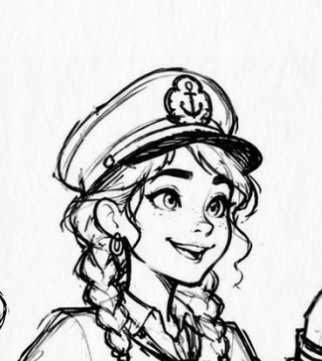
Sigil keep
• Wax seal stamp, your idea from V1 and we love it. V1 hero pose. (visual ref)
• Magnifying glass, inspecting documents for forgeries. Future card variant.
• Brass cipher wheel, a rotating code disc for verifying encrypted signals. Future card variant. (visual ref)
Silhouette test: The wax seal stamp in hand. No other character holds one.
Distinctive feature: Braids (keep your V1; they make her look young and eager, we love them). A tiny bell on her wrist that rings if she moves too fast (self-imposed). Peaked cap with a gold flag emblem optional but not required.
Build/energy: Compact, alert, slightly coiled. Young and eager. She WANTS to do the boring-but-important tasks. The undercover domain protector who's always on top of it. Like someone who's already checked the exits twice.
Friction: Lyra. Instinct vs. confirmation. They've had three arguments about whether "feels right" counts as data
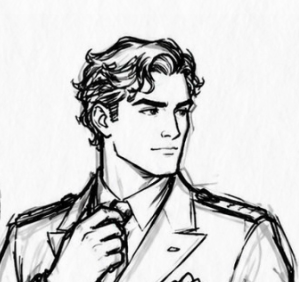
Quay (was Harbourmaster) redesign
• Ring of brass keys, each key = a different port/platform. V1 hero pose. (visual ref)
• Speaking trumpet, for calling dock orders across the harbor. Future card variant. (visual ref)
• Pocket watch, you had this in V1, we love it; keep. Timing the tides for departure. Future card variant.
Silhouette test: The ring of keys. No coat. He wears a heavy wool vest over a cable-knit sweater, rolled sleeves.
Distinctive feature: Weathered hands, salt-crusted boots. Looks like he's been standing on docks his whole life. Pocket watch (great detail from your V1; keep).
Build/energy: Broad-shouldered, grounded. Not the tallest but the most solid. Think harbor foreman, not admiral.
Friction: Spark. Spark rushes to warm before the infrastructure is ready

Cog keep
• Tool belt: wrenches, gears, chain. Anchor patch on sleeve. V1 hero pose. (visual ref)
• A small clockwork automaton: something he's building in his spare time, half-finished, gears exposed. Future card variant. (visual ref)
• A blueprint/schematic roll: the plans for the next machine, covered in grease thumbprints. Future card variant.
Silhouette test: The tool belt and work boots. Only character in a mechanic's jumpsuit.
Distinctive feature: Forearm tattoo of interlocking gears. Calloused hands. Always has grease somewhere.
Build/energy: Strong, muscular, arms often crossed. The guy you want when something's broken at 2am.
Best friend: Frida. He builds the engine, she paints the hull. They respect each other's craft deeply.
Friction: Quill. Cog thinks copy is decoration, Quill thinks automation is soulless. Productive tension.

Spark edit
• Flint and steel: fire-starter at his belt. V1 hero pose. (visual ref)
• Hand-bellows: for stoking the furnace. Oversized, like everything he owns. Future card variant. (visual ref)
• Oversized gloves: hand-me-downs from Cog, too big for his hands. Endearing. Future card variant.
Silhouette test: Smallest character + oversized coat/gloves. Instantly reads as "the kid."
Distinctive feature: Messy red hair (ember-red to match his color). Freckles. Soot EVERYWHERE: face, hands, clothes, even in his hair. Singed eyebrows. A small burn hole somewhere on his coat that he hasn't noticed yet. Always slightly out of breath and slightly on fire.
Build/energy: Wiry, short, fidgety. Youngest on the crew by far. The kid brother everyone protects but also teases. Seamus Finnigan energy: things combust around him and he just grins. Cheerful chaos, never malicious.
Friction: Petros. He thinks Spark counts too quickly, Spark thinks he's a nag. Mutual love underneath.
The thinkers. They decide who, when, and what to measure. Each one has a very different energy (a mapmaker, a helmsman, and a stargazer), so their clothing, posture, and props should reflect those different worlds.

Atlas redesign
• Rolled-up map: under one arm or spread on a table. V1 hero pose.
• Cartography dividers: the V-shaped measuring compass. Ink-stained fingers always. Future card variant. (visual ref)
• A brass armillary sphere: Portuguese navigation instrument, for measuring the world. Future card variant. (visual ref)
Silhouette test: The map roll + dividers. No one else carries these.
Distinctive feature: Rectangular glasses (reading glasses, not fashion). A compass rose tattoo on the back of his hand. Turtleneck + leather satchel, more academic explorer than military officer.
Build/energy: Lean, angular, looks like he forgets to eat when he's deep in a map. Older than his face suggests, the kind of person who's always been "old for their age."
Friction: Mira. She wants personal, he wants systematic. Both right, different scales.
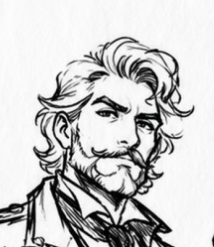
Tide edit
• Brass pocket watch on a chain: timing is everything. V1 hero pose. (visual ref)
• Ship's wheel: behind or beside him, his station. Future card variant.
• A barometer: brass, handheld or wall-mounted. He reads pressure changes before the storm hits. Future card variant. (visual ref)
Silhouette test: The beard + the pocket watch. The oldest-looking male character.
Distinctive feature: Full grey-streaked beard, weathered face, deep-set eyes. Wears a simple navy peacoat, plain and worn, more working sailor than decorated captain. Thick fingers. A calm face.
Build/energy: Stocky, broad, grounded. The kind of person who's survived storms and doesn't flinch anymore. Not tall but unmovable.
Friction: Lyra. She wants more sends to re-engage, he wants fewer sends to preserve reputation. Eternal debate.

Vega redesign
• Astrolabe, the classic navigation instrument for reading the stars. V1 hero pose. (visual ref)
• Small telescope, always pointed at the sky, never the sea. Future card variant.
• An hourglass. He measures time by the stars but keeps one for the crew who can't. Future card variant. (visual ref)
Silhouette test: The sextant/astrolabe. The only character who looks UP at the sky while everyone else looks at the sea.
Distinctive feature: Silver-framed round glasses (different shape from Atlas's rectangular ones). Pale skin: someone who works by starlight. A silver ear cuff.
Build/energy: Slim, tall, elegant. The opposite of Tide's stockiness. Moves slowly and deliberately. The kind of person who says three words and they're all right.
Friction: Quill. Vega measures what Quill creates. Quill finds it reductive. Vega finds copy unmeasurable. They need each other.
The makers. They write the words and design the look. Two very different energies: a gentle poet and a rock-and-roll artist.

Quill keep
• Quill pen, ink-stained fingers always. V1 hero pose. (visual ref)
• A stack of letters tied with ribbon, the ones she's perfected, ready to send. Future card variant.
• A small journal/notebook, tucked into her belt, dog-eared, full of crossed-out drafts. Future card variant.
Silhouette test: The flowing hair + the quill pen. Most elegant silhouette on the crew.
Distinctive feature: Long straight black hair, possibly with a simple hair pin or silk ribbon. Vietnamese features: delicate, precise, composed. Could wear a modernized áo dài-inspired top (high collar, flowing) over practical trousers, or a 70s-Vietnamese fusion look. Always has ink somewhere unexpected. (visual ref)
Build/energy: Willowy, graceful, light on her feet. The kind of person who sits on the deck railing at sunset writing in her journal. Quiet confidence: she doesn't need to be loud to be heard, her words do the work.
Friction: Cog. He thinks copy is decoration, she thinks automation strips the humanity out of emails.
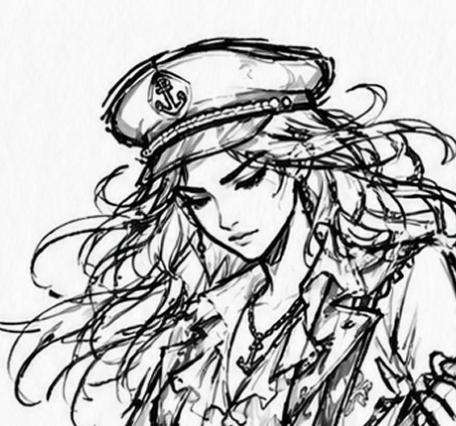
Frida keep
• Guitar, your choice from V1, we love it. V1 hero pose.
• Paint brushes, stuck in her hair, tucked in her belt, paint-splattered everything. Future card variant.
• A carpenter's plane or chisel. She's a shipwright, she builds AND paints. The tool says "I make things with my hands." Future card variant. (visual ref)
Silhouette test: The guitar + wild hair. Strongest silhouette in the entire crew.
Distinctive feature: Wild, voluminous hair (partially under a tilted sailor cap). Ornate heeled boots (you nailed these, keep). Bold energy: she takes up space.
Build/energy: Athletic, confident posture. Not delicate. She's a shipwright: she builds and paints. Think: rock star meets carpenter.
Friction: Vega. He measures what she makes. She thinks beauty can't be quantified.
The people people. They handle who comes in, who stays, and who drifts away. Grant guards the door, Mira makes it personal, Lyra keeps the pulse.

Grant redesign
• Open guest book: welcome register on a podium. V1 hero pose. (visual ref)
• A dock lantern: the welcoming light he keeps lit so nobody arrives in the dark. Future card variant. (visual ref)
• A jar of maple sweets: by the entrance, for every new arrival. Peak Canadian. Future card variant.
Silhouette test: Open posture + the guest book. The most approachable body language on the crew.
Distinctive feature: Classic Canadian red-and-green plaid flannel shirt (visual ref), sleeves rolled. Leather gloves (one on, one tucked in belt; the handshake is important). Friendly smile lines.
Build/energy: Medium build, open stance. Always facing you, never turned away. The first person you'd approach on a ship full of strangers.
Friction: Atlas. Atlas segments ruthlessly, Grant worries about excluding people who genuinely opted in

Mira keep
• Stirring spoon: wooden, oversized, always in hand or tucked in apron. V1 hero pose.
• A cast iron pan: heavy, blackened, been in the family for decades. Future card variant.
• A basket of bread: the Rhodes wood-oven bread she's always baking for someone. Future card variant. (visual ref)
Tattoos: Small anchor on forearm + traditional Greek protective tattoos (geometric patterns and crosses on wrists/hands, a real Cretan/Mani tradition from Ottoman occupation).
Silhouette test: The round, warm body shape + apron. Completely different build from any other character.
Distinctive feature: Curly hair, full cheeks, always smiling. The galley cook. Shortest woman on the crew. Rose-gold accents in her accessories.
Build/energy: Short, round, jovial. Everyone's auntie energy. Not old and thin/tired, but round and powerful. The woman who's been kneading bread since dawn and has arms to prove it. Has a lot to teach you and will whether you like it or not. Always moving, always cooking, always feeding someone whether they asked or not. One of the Siblings (with Petros and Lyra).
Friction: Atlas. She personalizes by instinct, he segments by data. Different approaches to "know your audience."

Lyra edit
• Walkie-talkie/radio: at her hip, always communicating. V1 hero pose.
• A small briki: the Greek coffee pot, always mid-pour or in hand. One spoon coffee, two spoons sugar. Future card variant. (visual ref)
• An anchor pin: you had this in V1, we love it. Subtle sibling detail. Future card variant.
Silhouette test: Dynamic posture: she's the one in motion while others stand still. Leaning forward, gesturing, hand on hip.
Distinctive feature: Curly bob, shorter and bouncier than Quill's long waves, so they read as very different silhouettes. Coral-red scarf or sash. Always an anchor detail somewhere. She's the ship's social energy.
Build/energy: Medium height, athletic, always in motion. The person at the party who's talking to everyone. One of the Siblings (with Petros and Mira).
Friction: Sigil. Instinct vs. data. They've argued about whether "feels right" counts as evidence. Lyra won two of three arguments.
The lawkeeper. One person who holds the line on regulations.

Warden edit
• Jitte: Edo-period police weapon, metal rod with a hook. The badge of law enforcement in feudal Japan. Unique silhouette. V1 hero pose. (visual ref)
• Sensu (folding fan): Japanese officials snapped these open when making rulings. Elegant authority. Future card variant. (visual ref)
• Inro: small ornate lacquered container hung from belt sash. Carried seals and medicine. Distinctly Japanese, nothing else on the crew looks like it. Future card variant. (visual ref)
Silhouette test: The jitte in hand or at his belt. No other character carries a weapon-shaped tool.
Distinctive feature: Short, neat hair, the most "put together" male character. Japanese features, clean jawline. A red neckerchief (you had this, great instinct, keep). Standing straight, shoulders back. The samurai-police energy comes through in posture and composure, not costume.
Build/energy: Trim, upright, military posture without the military costume. Someone who takes his appearance as seriously as his regulations.
Friction: Lyra, she wants to push boundaries to re-engage, he wants to stay safe. Productive tension between growth and compliance.
The eyes. They watch the horizon, the hold, and the rules. Three very different watchers: a lookout for threats, a lookout for policy shifts, and a quartermaster who watches the cargo.
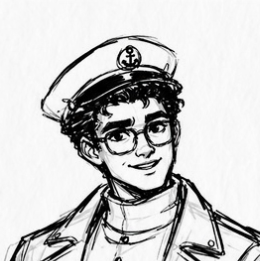
Reef edit
• Binoculars: around his neck, always. V1 hero pose.
• A signal flag: rolled or draped over his shoulder, for warning the crew below. Future card variant. (visual ref)
• Carved turtle pendant: Turtle clan. Small, wooden, always visible at his chest. Include in all poses. (visual ref)
Silhouette test: The binoculars + looking-into-distance posture. He's the only character whose gaze goes OUTWARD.
Distinctive feature: Longer hair, loose or tied back casually. Small carved turtle pendant (Turtle clan). Trade silver arm band. No tattoos, clean-faced, relaxed. The chill twin.
Build/energy: Young, lean, relaxed but alert. One Piece protagonist energy: adventurous, spirited, been at sea his whole life. One of the youngest on the crew but one of the most knowledgeable because he started earliest. He'll end up being the most experienced person on the ship simply because of the head start.
Friction: Echo (his twin), Reef is easy-going, Echo is intense. Same data, different temperaments.
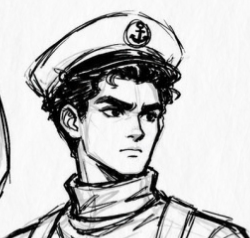
Echo edit
• Ear trumpet / listening horn: pressed to the wind, intercepting signals. V1 hero pose. (visual ref)
• A notepad: where he logs every policy change. 400 pages and counting. Future card variant.
• Wolf tooth on a cord: Wolf clan. Worn around his neck, always visible. Include in all poses. (visual ref)
Silhouette test: The listening device + intense forward lean. Where Reef looks outward, Echo leans IN.
Distinctive feature: Same face as Reef (twins) but sharper expression, more intense eyes. Traditional crest hairstyle (partially shaved sides, the real Mohawk, from the Mohawk nation). Geometric tattoo on one forearm. Wolf tooth or claw on a cord around his neck (Wolf clan). Trade silver gorget (crescent chest piece). Darker clothing than Reef.
Build/energy: Same build as Reef but different posture, leaning forward, alert, coiled. The intense twin who never relaxes.
Friction: Reef (his twin), Echo thinks Reef is too relaxed about threats. Reef thinks Echo worries too much.
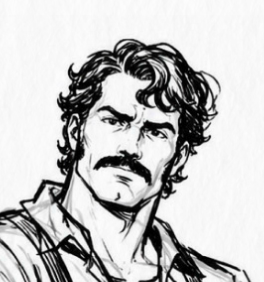
Petros (was Vera) redesign
• Deck brush: stiff bristle, he's always scrubbing something. V1 hero pose. (visual ref)
• A brass weighing scale: for checking the cargo isn't dead weight. One side always heavier. Future card variant. (visual ref)
• A bucket and rag: within reach at all times. The man cleans like he breathes. Future card variant.
Silhouette test: The deck brush + stocky build + mustache. He's the one who looks like he's working while everyone else is posing.
Distinctive feature: Sea-foam green cable-knit sweater, cream apron over work clothes, thick salt-and-pepper mustache. Weathered cheeks, sandals with socks (yes, really). Slightly skeptical expression, always.
Build/energy: Stocky, broad, sturdy. If you saw him drinking coffee you'd think he's just an old man, but he can stop a baseball bat with his hand and not bat an eye. Wise, friendly, helpful. Never an asshole, never thinks he's better than you. He's a protector, shows love by cleaning your mess before you wake up. Middle brother, between Mira (eldest) and Lyra (youngest).
Friction: Spark, Petros thinks he counts too quickly, Spark thinks Petros is a nag. It's mutual love.
The healer. When reputation is damaged and blocklists have hit, Neem is the one who brings you back.
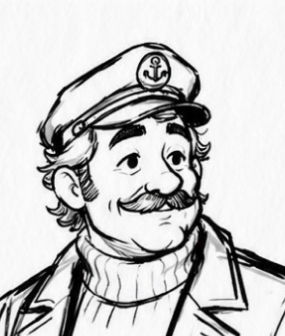
Neem keep
• Leather medical bag: old, worn, always within arm's reach. V1 hero pose. (visual ref)
• Mortar and pestle: grinding remedies by hand. Ayurvedic practitioner energy. Future card variant. (visual ref)
• A brass diya: traditional Indian oil lamp. The light he keeps burning in the hold for anyone who needs him at 3am. Future card variant. (visual ref)
Silhouette test: The medical bag + the oldest/shortest male character. Grandfatherly silhouette.
Distinctive feature: White/grey curly mustache. Warm turtleneck under a heavy coat. Reading glasses pushed up on forehead. The kindest face on the crew.
Build/energy: Short, round, soft. The oldest human crew member. Grandfatherly warmth. Moves slowly but every movement is purposeful.
Friction: Spark, Spark's impatient warming creates the messes Neem has to fix.
The truth-teller. The Whisper sees what no one else will say: the myths, the vendor lies, the convenient omissions.
The Whisper new character
• Crystal ball (small, handheld): oracle energy. Cloudy inside, like the mist around them. V1 hero pose. (visual ref)
• Rune stones: scattered or held in one palm. Ancient divination, reading what's hidden. Future card variant. (visual ref)
• A wisp of wind / breath: visible exhale or a ribbon of purple-grey mist curling from their fingers or lips. They ARE the whisper, the air moves when they speak. Future card variant. (visual ref)
Silhouette test: The veil + mist edges. The only character who isn't fully "solid"; their edges blur into purple-grey fog.
Distinctive feature: Face partially hidden, either a translucent veil (visual ref), a low hood that shadows the upper face, or wisps of mist that obscure features. The effect: you can ALMOST see the face but never fully. Gender ambiguous. Long dark hair visible beneath the veil/hood. One eye catches light, sharp, direct, knowing. Minimal accessories, the mystery IS the accessory. Skin tone unplaceable, not pale, not dark, just impossible to categorize. Always drawn leaning close to someone's ear, or partially visible, never standing front and centre like the other characters. (more refs)
Build/energy: Tall, still, composed. They don't move much, when they whisper, people stop. The opposite of Lyra's energy. They appear in the mist, speak to one person, and fade before anyone can turn around.
Friction: Not friction exactly, more like the moment when someone realizes they're right and has to go back and redo something. Nobody's mad at The Whisper. They're mad at themselves for missing it.
Not crew. Not captain. Delphi is the ship itself, the spirit that holds it all together. Always present, always watching, eight arms in eight places at once.
 Delphi redesign
Three hearts. One pumps blood to the body. Two pump blood to the gills. She literally has more heart than anyone on the ship. (Email deliverability also runs on multiple engines: DNS, authentication, reputation. If one stops pumping, the whole thing suffocates.)
Blue blood. Copper-based, not iron like ours. She's built different. Works better in cold, low-oxygen environments where everyone else would slow down. RME works where other tools give up: the messy lists, the old data, the "we haven't cleaned this in three years" jobs.
Always teal. Real octopuses camouflage, but Delphi doesn't; she's always RME teal. The crew adapts, pivots, changes approach. Delphi stays the same colour no matter what room she's in. She IS the brand. Her shade shifts subtly (lighter when playful, darker when serious), but the base is always that deep ocean teal. She's the one constant on a ship full of specialists.
Boneless. She can squeeze through any gap her beak fits through. Gets into places nothing else can reach. That's RME finding the problems hiding in your data that other tools miss: the role-based addresses, the recycled traps, the domains that LOOK fine but haven't accepted mail in six months.
Tool use. Octopuses carry coconut shell halves to use as portable shelter. One of the only animals that uses tools. Delphi doesn't just observe; she grabs what she needs and solves the problem.
The 8 tentacles are NOT a 1:1 map to 8 disciplines (there are 18 crew members, not 8). The arms represent something subtler: she touches everything without controlling anything. She's in the galley, the engine room, the seal room, the crow's nest, all at once. But she doesn't run any of them. She connects them. She's the nervous system, not the brain.
Examples of what she might be doing in someone else's card:
• Stealing snails from the bucket Mira keeps for her, while Mira's back is turned
• Handing Cog the wrong tool (a fish instead of a wrench)
• Sitting on Atlas's map, one tentacle pointing at something he missed
• Wearing Spark's goggles on one tentacle, his gloves on another
• Curled around Reef's binoculars, looking through them upside down
• One tentacle poking out from The Whisper's hood/mist
• Wrapping around Petros's mop handle while he's trying to use it
• Holding Sigil's wax seal stamp, "inspecting" it very seriously
She should NEVER look scary, menacing, or Kraken-like. She's small (cat-sized), expressive, a little smug, and clearly having the best time on the ship.
Distinctive feature: One tentacle is always slightly raised, like a hand about to tap someone's shoulder. A "psst, look at this" gesture. Also: her eyes glow faintly gold when something important is about to happen (subtle foreshadowing in illustrations).
Easter egg potential: Delphi can appear in ANY character's card, hidden in the background, peeking from a barrel, curled around a prop. Like Where's Waldo but with tentacles. Scarlet has full creative freedom on where to hide her.
(style ref) (nautical mascot ref) (brass aesthetic ref)
| Character | G | Origin | Birthday | Verdict | Key change |
|---|---|---|---|---|---|
| Sigil | F | Italian | Sep 3 · ♍ | keep | Keep braids + wax seal. Young, eager protector. |
| Quay | M | Dutch | Apr 28 · ♉ | redesign | Vest + keys, harbor foreman energy. |
| Cog | M | Scottish | Jan 11 · ♑ | keep | Mechanic look is perfect. More copper-orange. |
| Spark | M | Irish | Mar 21 · ♈ | edit | Rename from "Apprentice." Red hair, scrappy kid. |
| Atlas | M | Portuguese / Moroccan | Nov 9 · ♏ | redesign | Explorer/cartographer. Scarlet picks origin. |
| Tide | M | West African | Jul 2 · ♋ | edit | Simplify costume. Worn peacoat, deep calm. |
| Vega | M | Persian | Feb 8 · ♒ | redesign | Stargazer. Silver palette. Round glasses. Looks UP. |
| Quill | F | Vietnamese | Jun 5 · ♊ | edit | Vietnamese features + áo dài-inspired. Inkwell-purple. |
| Frida | F | Brazilian-Mexican | Aug 9 · ♌ | keep | Best design in the set. Benchmark. |
| Grant | M | Canadian | May 14 · ♉ | redesign | Warm welcomer: plaid vest, rolled sleeves. |
| Mira | F | Greek | Nov 23 · ♐ | keep | Galley cook is perfect. Push rose-gold. |
| Lyra | F | Greek | Jun 21 · ♋ | edit | More dynamic/social. Shorter hair. Coral-red. |
| Warden | M | Japanese | Jul 18 · ♋ | edit | Upright posture, quiet authority. Jitte + sensu. |
| Reef | M | Haudenosaunee | Oct 26 · ♏ | edit | Binoculars, storm-grey, relaxed lounging. Turtle clan. |
| Echo | M | Haudenosaunee | Oct 26 · ♏ | edit | Darker clothes, forward lean, ear trumpet. Wolf clan. |
| Petros | M | Greek | Mar 16 · ♓ | redesign | Was Vera. Greek uncle. Deck brush, sandals with socks. |
| Neem | M | Indian | Dec 28 · ♑ | keep | Kindly healer. Ayurvedic energy. Warm-brown/green. |
| The Whisper | ??? | Unidentifiable | Dec 21 · ♐ | new | NEW. Crystal ball, mist, oracle. No gender, no nationality, no age. |
| 🐙 Delphi | F | The Ship | — · — | redesign | Ship's octopus mascot. Existing art, new style treatment. Easter egg in every card. |
- Reef + Echo, the twins in the crow's nest
- Quill + Frida, the creative duo on the open deck
- Cog + Spark, mentor and apprentice in the engine room
- Petros + Mira + Lyra, the Siblings (group shot)
- Atlas + Tide, the strategists over the chart table
- Grant + Warden, welcome and rules, the dock gatekeepers
- The Whisper + Vega, uncomfortable truths over black coffee
18 characters from 13 cultures. Every origin was chosen because the culture genuinely enriches the character's discipline, no tokenism, no accidents.
Sigil the Signaler
Sigil grew up in Venice where her father was a harbor notary, the man who stamped every cargo manifest, verified every captain's seal, and caught forgeries before bad goods entered the port. The Venetian Republic ran on authenticated documents for centuries, and her family had been part of that chain since her great-grandfather. By age 10 she was sitting on his lap watching him work. By 12 she was catching fakes he missed.
The trick, she learned, wasn't looking at the seal itself. It was the pressure. A real stamp is pressed with confidence: one motion, centered, decisive. A forgery hesitates. The wax spreads unevenly. The edges blur. She could feel the difference with her fingertip before she could see it with her eyes.
Her father said: "Anyone can copy a seal. Nobody can copy the hand behind it."
The Captain found her working the night shift at a port authority office in Piraeus, age 19, catching fraudulent cargo papers that had slipped past every other inspector. Three ships in one week, all with perfect-looking credentials, all carrying contraband. Nobody else saw it.
"How did you know?" the Captain asked.
"The DKIM signature on the third one was aligned to a different domain than the envelope sender. The SPF passed, but the DMARC policy was set to 'none', which means nobody was even checking. It's like leaving your front door open and putting a sign that says 'locked.'"
The Captain offered her a position that night. Sigil asked for 24 hours to think about it. She said yes in 3.
Up before dawn. Coffee (strong, no sugar) from the pot Lyra left for her (Lyra's coffee is too sweet, but it's the gesture that matters). First stop: the seal room. She checks every outbound message's authentication before it leaves the ship. SPF alignment, DKIM signatures, DMARC reports from the previous night.
Most mornings are quiet. Routine checks. Green across the board. But twice a month, something flags: a misconfigured subdomain, a third-party sender whose DKIM key rotated, a new marketing platform that nobody told her about. Those are the mornings she lives for.
Lunch with Quay (they argue about whether infrastructure or authentication is the foundation; it's the same argument every day, neither will concede). Afternoons: training new crew members on what authentication actually means. Evenings: updating the seal registry, reading DMARC aggregate reports, occasionally having a quiet beer with Cog in the engine room.
Goes to bed with a magnifying glass on her nightstand. Just in case.
The Perfect Forgery: A merchant ship arrived with flawless credentials: SPF passed, DKIM valid, DMARC aligned. Sigil let it through. That night, she couldn't sleep. Something felt wrong. She went back and checked the DKIM selector. It was using a key that had been published only 6 hours before departure. A real key would have been in place for weeks. She caught the ship at dawn. The cargo was counterfeit. Lesson: authentication passing doesn't mean authentication is trustworthy. Check the age and history, not just the result.
The Cousin Domain Attack: One morning, Grant noticed that new subscribers were complaining about "the weird email you sent yesterday." The crew hadn't sent anything. Sigil dug in. Someone had registered reviewmyernails.com (r-n looks like m in most fonts) and was sending phishing emails that looked identical to the ship's real messages (same design, same copy, same logo). The authentication was technically valid because the scammer had set up their OWN SPF and DKIM on their fake domain. Everything "passed." Sigil's lesson to the crew: "Authentication doesn't tell you if a domain is TRUSTWORTHY. It tells you if an email really came from that domain. A criminal with a perfectly stamped passport is still a criminal." She set up domain monitoring alerts, registered the ten most likely cousin domains, and published a strict DMARC policy telling inbox providers: "If an email claims to be from us and fails our authentication, reject it. Don't even put it in spam. Kill it." The phishing stopped within 48 hours.
Mira says she's close.Quay has to pull rank sometimes and say "it's good enough, let it sail." She hates that phrase.Quay the Dockmaster
Third-generation Rotterdam dockmaster. His grandfather built the port's first modern berthing system. His father expanded it to handle container ships. Quay was born into the smell of salt water and diesel fuel, and he knew every crane operator, pilot boat captain, and customs clerk by name before he was 15.
He learned early that every port has different rules. Rotterdam's deep water meant big ships but strict scheduling. Amsterdam's narrow channels meant smaller vessels but faster turnaround. Hamburg required different paperwork entirely. The cargo didn't change, but the PORT dictated everything.
"Wrong port, wrong rules. Pick before you pack."
Quay never planned to sail. He was a port man, born on the dock, raised on the dock, perfectly happy on the dock.
Then the Captain arrived. Her ship had been bouncing between ports for months: rejected at one for bad paperwork, turned away at another for sending too much mail at once, throttled at a third because her reputation had taken hits. She was frustrated, exhausted, and running out of ports that would take her.
Quay met her at the gangplank, looked at her ship's papers, and said: "I can see why they turned you away. But I can also see you're not a spammer, you're just badly set up. Give me a day."
He spent 14 hours rebuilding everything. By morning, every port in the Atlantic would accept her. She offered him a position on the crew. He said he didn't leave ports. She said: "What if the port came with you?"
He thought about it for exactly one Taurus minute (three hours), then packed his keys and boarded. He's been aboard ever since. The ship's dock IS his port now.
First one awake. Checks the tides, the weather, the port conditions at every destination they might visit today. Reviews the infrastructure status: are the IPs healthy? Are the sending domains resolving? Is the feedback loop from yesterday's port still processing?
Morning: walks the deck with his ring of keys, checking every lock, every hatch, every connection point. Each key represents a different platform, and he knows which one opens what. Argues with Sigil over coffee about whether infrastructure or authentication matters more (the answer is both, but neither will say it).
Afternoon: handles the complicated stuff. New ESP migration. IP warm-up coordination with Spark. Negotiating sending limits with a port authority that's tightened their rules. He does this on the speaking trumpet (an old-fashioned megaphone shaped like a cone), loud, clear, no ambiguity.
Evening: the pocket watch comes out. He times everything. How long until the next tide? How many hours of sending window remain? When does the reputation reset cycle? He knows these numbers by heart but checks them anyway. Taurus energy: trust the routine.
The Port Switch Disaster: The crew decided to switch ESPs mid-campaign. "It's just a platform change," someone said. Quay stopped them. "You're asking me to move a fully loaded cargo ship from one port to another while the cargo is still being delivered. You need to: redirect the mail streams, warm the new IPs, update every DNS record, verify authentication on the new platform, AND maintain delivery on the old one until the switch is complete." It took three weeks of careful migration instead of the one-day cutover they'd planned. Zero messages lost.
The Private Dock vs. Shared Dock: A new crew member asked why they needed their own private dock when they could share one, it's cheaper. Quay walked them down to the harbor and pointed at two ships. One had its own dock, it could load, unload, and leave on its own schedule. The other shared a dock with six other ships. "See that shared dock? If ANY of those six ships gets caught smuggling, the port authority shuts down the WHOLE dock. Your ship is clean, but you can't sail either, you're guilty by association." It's the same with email: you can send from your own private address, where your reputation is yours alone, or share one with strangers, where one bad neighbour can get everyone's emails blocked.
Mira's version, "good, but not Dutch good."Cog the Engineer
Glasgow shipyard kid. Could disassemble a steam engine at 8, rebuild it better at 10. His mother said he came out of the womb holding a wrench (his father disputes this but can't prove otherwise). By 14 he'd built an automated bilge pump (a pump that removes water from the bottom of a ship) from scrap metal and a broken clock. His section of the yard never flooded again.
He didn't learn engineering in school. He learned it by watching things break and figuring out how to make them not break again. Every machine, he said, is just a series of "if this, then that" statements, and if you understand the logic, you can make anything run without human hands touching it.
"Automation isn't about replacing people. It's about freeing them to do the things machines can't."
The Captain's automation system was held together with string, duct tape, and prayer. Three welcome emails were firing simultaneously, the re-engagement flow was sending to people who'd bought yesterday, and the birthday trigger was six months late for half the list.
Cog walked into the engine room, looked at the pipes and valves and wires, and said: "Who built this?"
Nobody answered.
"Right. Give me a week."
He rebuilt the entire system. By day 3, he'd found 14 redundant triggers, 8 conflicting rules, and a flow that was sending an apology email for a problem that had been fixed two years ago. By day 7, every automation ran clean. He never left.
The Over-Automation Crisis: A crew member wanted to automate EVERYTHING: every touchpoint, every response, every follow-up. Cog let them build it. Then he waited. Within a week, a subscriber received 11 automated emails in 3 days because they'd triggered multiple flows simultaneously. Cog pulled the plug, brought the crew member to the engine room, and pointed at the pipes: "See how these all connect? If you open every valve at once, the system floods. Automation needs governors: frequency caps, mutual exclusions, cool-down periods. The machine needs to know when to STOP, not just when to start."
The Human Touch: Quill came to Cog furious. She'd written a beautiful welcome email (warm, personal, formatted with care). But Cog's system had sent it out looking like a plain text document: no bold, no spacing, no personality. Like printing a love letter on a receipt. Cog looked at it and understood immediately. He didn't just fix the system. He sat with her. "Show me what your words are supposed to LOOK like, so I can build a machine that keeps your voice intact." They spent three hours together, Quill pointing at details ("this pause matters, this line break is intentional"), Cog adjusting his system to respect each one. Now every automated email goes through a "does this still sound like a person wrote it?" check before sending.
Spark has to pull him back sometimes: "Cog, it's a welcome email, not a spaceship." He knows Spark is right. He builds the spaceship anyway.Spark the Powder Monkey
Grew up on Inis Mór, the biggest of the Aran Islands off the west coast of Ireland, a place of stone walls, Atlantic storms, and exactly zero central heating. His family's cottage relied on a peat fire that had to be kept alive year-round. Go too hot, you burn through a week's fuel in a night. Go too cold, the fire dies and you start from scratch in a frozen kitchen.
Spark was the fire kid. From age 7, it was his job to keep it burning: steady, consistent, never out. He learned that a fire isn't something you light once. It's a relationship. You feed it a little, let it catch, feed it more, let it grow, and eventually it sustains itself. Rush it with too much fuel too fast and you choke it. Neglect it and it dies.
He was brilliant at it, but impatient. He kept trying to make the fire BIGGER than it needed to be. His mother would come downstairs to find the kitchen glowing orange and Spark grinning: "It's grand, it's grand." It was not grand.
At 15 he left the island on a fishing boat, worked as a stoker (the person who feeds coal into a ship's boiler) on three different ships, and got fired from all three for the same reason: he ran too hot. Then Cog found him on a dock in Galway, hands black with coal dust, trying to talk his way onto a fourth ship. Cog watched him for five minutes and said: "You understand fire. You just don't understand patience yet. I can teach you that."
Cog brought him aboard as his apprentice. The Captain was skeptical: "he's a child, and he's been fired from three ships." Cog shrugged: "He's been fired because he runs hot. But he understands heat better than anyone I've met. He just needs someone to teach him the dial has more settings than MAX."
His initiation test: warm up a brand-new sending engine from cold to operational, slowly, over three weeks, without rushing a single step. Like keeping his mother's peat fire alive, but with even more patience. He managed it perfectly. No shortcuts. He followed the plan to the letter. Cog was proud. The Captain was relieved.
Then Spark celebrated by lighting a small bonfire on the forecastle (the raised deck at the front of the ship). Petros spent an hour cleaning the soot and didn't speak to him for two days.
"It's GRAND."
The 3-Day Warm-Up: Spark's most famous disaster. He tried to warm a new IP in 3 days instead of 3 weeks because "the campaign needs to go out Friday." Day 1: sent 500 emails, fine. Day 2: sent 50,000, flags everywhere. Day 3: sent 200,000, IP blacklisted across three major providers. The resulting cleanup took Neem a month. Cog made him write out the warm-up schedule by hand, every day, for two weeks. Spark now carries a laminated warming calendar in his back pocket.
What He Teaches: Despite the chaos, Spark is actually the best person to teach warming because he's made every mistake. New crew members love him because he doesn't pretend to be perfect: "See this scar? That's from the time I sent 100K emails on day one of a new domain. See this one? That's from when I forgot to authenticate the subdomain before warming it. Learn from my burns; there are plenty to choose from."
Mira's sourdough bread (Mira pretended not to see).Cog has confiscated his speaker twice.Cog will stop believing in him. He'd never say this. He shows it by trying harder (which sometimes causes more fires, which is the fundamental paradox of Spark).Cog to keep reminding him that patience isn't weakness. It's the hardest kind of strength.Atlas the Cartographer
University-trained cartographer who spent his twenties charting coastlines nobody had mapped accurately since the Portuguese Age of Exploration. He sailed with research vessels, drew by hand when the GPS failed, and learned that a map is only as good as the mapmaker's understanding of WHO will use it.
The moment that changed him: a cargo ship ran aground using his chart because he'd drawn it for experienced navigators but the crew was inexperienced. The channel was correctly mapped, but the approach angle was only safe for ships that could turn quickly. He hadn't marked the danger for slower vessels. Nobody was hurt, but he never forgot.
"A chart that's technically correct but doesn't serve the reader is just decoration."
The Captain was sending the same email to every subscriber, 50,000 people getting identical content regardless of whether they'd been reading for years or signed up yesterday. Atlas watched her hit "send" and physically winced.
"You just sailed into seven different harbors using the same approach chart."
"It's the same message. Why would I change it?"
"Because your long-time readers are advanced navigators and your new subscribers don't know port from starboard. You're boring the experts and confusing the beginners. Both stop coming."
He drew seven different versions of the same campaign on a napkin. Open rates tripled within the month.
Tide says it's depressing. Atlas says it's accurate.Mira found his sketchbook once and he didn't speak to her for two days.Mira has to remind him: "Not every meal needs 15 ingredients. Sometimes bread and olive oil is enough."Tide the Helmsman
Grew up in a fishing village on the Ghanaian coast where the elders read the tides by feel. His grandfather could tell you when the fish would run three days before the nets went in, not from charts or instruments, but from the rhythm of the waves, the color of the sky at dusk, the way the seabirds flew.
Tide learned that WHEN you act matters more than how hard you try. Cast your net at the wrong time and you pull up nothing. Cast it at the right time and the ocean gives you more than you can carry. The same effort, the same net, the same water, only the timing changes.
He became the most respected tide-reader on the Gold Coast. Ships would delay departure by days to wait for his word.
The Captain was sending emails at random, Monday morning blast, then nothing for two weeks, then three emails in one day, then silence. Her engagement was a rollercoaster. Tide watched for a week, saying nothing, just noting the patterns.
Then he sat her down.
"You're casting your nets at high tide when the fish are at low. Tuesday morning your readers are at their desks. Thursday afternoon they're in meetings. Sunday evening they're preparing for the week. You're emailing on Saturday nights."
"How do you know all that?"
"I watched the water."
The Fishing Lesson: A new crew member wanted to send 5 emails a day. Tide said nothing. He took them fishing. They sat on the dock for 6 hours. Nothing. Then the fish came, 20 minutes of furious activity, more than they could carry. "That's cadence. You wait for the rhythm, then you move with it. If you cast all day, you tire your arms and scare the fish."
The Silence Strategy: The Captain panicked during a slow engagement month and wanted to increase frequency. Tide stopped her. "When the tide goes out, you don't chase the water. You wait. If you send more when they're pulling away, you push them further. Let the rhythm come back to you." They reduced frequency for two weeks. Engagement recovered on its own.
Lyra pushes him, "the fish are HERE, Tide. NOW." He needs her urgency to balance his calm.Vega the Navigator
Son of astronomers in Isfahan. His family had been mapping the stars for six generations. They named constellations, built observatories, calibrated astrolabes. But Vega saw something they didn't: the stars weren't just for navigation. They told you WHERE you were AND what was coming.
His breakthrough: tracking which stars were visible through different atmospheric conditions revealed weather patterns 72 hours before they arrived. He didn't just read the sky. He read the story the sky was telling about the future.
"The data doesn't just tell you where you are. It tells you where you're going. Most people only read the first sentence."
The Captain had data everywhere, dashboards, spreadsheets, reports, but no one who could READ them. Vega looked at her analytics for ten minutes and said: "Your engagement rates tell a story you're not hearing. Your best-performing emails last quarter were the ones you almost didn't send. Your worst were the ones you were most confident about. Can I show you why?"
He spent two hours drawing star charts of her data. Lines connecting metrics that nobody had thought to compare. When he was done, the Captain said: "I've been flying blind."
"Not blind. You had the stars. You just weren't looking up."
Mira leaves him a plate because she knows.Tide has to tap him on the shoulder: "Vega. The storm you predicted three days ago? It's HERE. What do we do?" He snaps into action beautifully, but he needs the push.Lyra the Bosun (crew manager, the person who keeps the whole team running day to day)
Lyra grew up on Rhodes, the Greek island where ancient ruins sit next to tourist cafés and the old town is a maze of cobblestone alleys where everyone knows everyone. She was the kid who'd sit in the harbor café counting how many tourists smiled versus how many looked lost, then report back to the café owner: "Today's a good crowd, they'll stay for dinner." She was usually right.
Her grandmother ran a guesthouse and taught her the art of reading a room. Not body language books or psychology, just years of watching faces, noticing who needs water before they ask, who's about to leave before they stand up. Lyra absorbed it the way some people absorb music.
She went to university in Athens for hospitality management but spent most of her time in the campus bar, not drinking, just watching. She could predict which tables would tip well, which couples were on a first date, and which groups were about to get too loud, all within 90 seconds of them sitting down.
"People tell you everything before they say a word. You just have to listen with your eyes."
Mira brought her. They're siblings, Mira is the eldest, Petros the middle brother, and Lyra the youngest. Where Mira goes, Lyra eventually follows, not out of dependence, but because her big sister has a habit of finding situations that need Lyra's specific gift.
The Captain had a problem: great content, solid authentication, clean lists, but engagement was flatlined. People were subscribed but not reading. Not unsubscribing either. Just... there. Ghost subscribers haunting the list like passengers who'd booked a cruise but stayed in their cabins.
Lyra walked around the ship for a day, talked to no one, just watched the message flows. That evening she sat with the Captain.
"Your problem isn't that people don't like your emails. It's that your emails don't notice people. You send the same energy to someone who reads every word and someone who hasn't opened in six months. The loyal reader feels unappreciated. The dormant one feels spammed. You're treating a conversation like a broadcast."
She built an engagement scoring system that night. Simple, intuitive, based on behavior patterns she could explain to anyone. Segment by how people ACT, not just who they ARE. The ship's engagement rates climbed 40% in a month.
Lyra's mornings start with Mira. Coffee on the deck. Lyra makes it too sweet. Mira says nothing. Sigil says "how do you drink that." They review last night's engagement data together. Mira handles the personal touches; Lyra reads the pulse of the crowd.
Mid-morning: she walks the ship checking the "temperature" of each message flow. Not the metrics, the feeling. Is the welcome sequence warm enough? Is the re-engagement flow desperate or dignified? She'll read a draft and say: "This email sounds tired. Was it written on a Friday afternoon?" (It usually was.)
Afternoons: she cross-references with Reef. His blocklist data plus her engagement data tells a full story: if reputation drops AND engagement drops, something structural broke. If reputation holds but engagement drops, the content is the problem, not the infrastructure. They speak in half-sentences and nods, like old friends playing chess.
Evenings: she sits in the crew mess and listens to conversations. Not to eavesdrop; to feel the crew's mood. A stressed crew writes stressed emails. She's the one who says: "Let's take tomorrow off the send schedule. Everyone's running on fumes and the subscribers will feel it."
The Ghost Ship: 30% of the list hadn't opened an email in 90 days. Someone suggested deleting them. Lyra said wait. She split the ghosts into three groups: people who'd stopped opening (genuine disinterest), people who'd stopped opening but were still clicking links in emails they "hadn't opened" (their email client was blocking open tracking; they were VERY engaged, just invisible), and people who'd recently gone silent after months of activity (life happened, vacation, job change, new baby). She sent each group a different re-engagement message. The "invisible engaged" group needed nothing, they were already there. The "life happened" group responded to a warm "we're still here when you're ready" note. Only the truly disengaged got a sunset email. She saved 11% of the list from deletion.
The Applause Meter: She taught the crew to think of engagement like a live audience. "If you're a comedian and the front row is laughing but the back row is on their phones, you don't have an audience problem, you have a volume problem. The front row is your engaged segment: give them insider content, early access, the good stuff. The back row is your casual segment: give them shorter, punchier, less frequent sends. And the people who left during intermission? Let them go with grace."
Mira get a box every time they visit home.Mira doesn't believe her but they watch it together anyway.Mira (they knock a pattern when they want to talk, three short, one long). Warm, messy, fairy lights, a corkboard of engagement trend printouts mixed with photos of the old town.Mira gently reminds her: "Letting go is also an act of care." Lyra knows she's right. She still checks on them anyway.Quill the Scribe
Quill grew up in Hoi An, a town built on lanterns and language. Her mother was a poet who sold verses at the night market, tourists would describe a feeling, and her mother would write it into a poem in under a minute, in any of four languages. Her father ran a printing press. Between them, Quill learned that words are cargo: pack them wrong and they arrive damaged. Pack them right and they can change someone's day.
She started writing letters for fishermen, men who'd been at sea for months and needed to tell their families they were safe, they missed them, the catch was good. They'd describe the feeling; she'd find the words. She learned that the best writing doesn't sound like writing at all. It sounds like someone talking to someone they love.
At 18 she won a national poetry competition with a piece about a subject line, just the subject line of her father's emails to her mother, sent every Friday for 20 years. The same subject: "Still here." Two words. The judges cried.
"A subject line is a door. If it looks like every other door on the street, nobody knocks."
The Captain's emails had great data, great delivery, great authentication, and nobody read them. Subject lines like: "Q3 Newsletter: Updates and Information." Open rates: 8%.
Quill was working at a café in Da Nang when the Captain complained about it. Quill overheard, walked over, looked at the screen, and said: "Can I try something?"
She rewrote 5 subject lines in 3 minutes:
"Q3 Newsletter: Updates and Information" became "We almost lost Client A. Here's what saved them."
"New Feature Announcement" became "The button you've been asking for is here."
"Monthly Recap" became "Last month you sent 4,200 emails. One of them changed everything."
The Captain sent them that afternoon. Open rates: 34%. Quill was on the ship by dinner.
"You were telling them WHAT was inside. I told them WHY they should care."
Quill writes in the mornings. Not emails, morning pages. Three handwritten pages in a leather journal, in Vietnamese, about whatever's in her head. She says it "clears the pipes" so the real writing flows cleaner.
Then: phở. Always phở for breakfast. She eats it at her desk, which is a disaster zone of crumpled drafts, ink pens (she drafts by hand before typing), a worn Vietnamese-English dictionary, and three cups of cà phê s đá at various stages of completion.
She writes subject lines first, sometimes 40 variations for one email. Tests them on crew members: "Which of these would make you click?" Frida is her best test subject because Frida is honest. Cog is her worst because he says "I'd click on any of them, they're all fine" (they are not all fine).
Afternoons: body copy, CTAs, footer text, the unsubscribe line (she considers this the most important sentence in the email: "it's the last thing they read and the last impression you make"). She reviews every email before it goes to Frida for design.
Evenings: she reads. Not emails, novels, poetry, song lyrics, menus, shampoo bottles. "Good writing is everywhere. You just have to read with the part of your brain that notices rhythm."
The Subject Line Tournament: Quill invented a game the crew plays monthly. Everyone writes a subject line for the same email. They read them aloud without names. The crew votes on which one they'd open. Quill has won 23 out of 30 tournaments, but she's most proud of the time Spark won with: "I set something on fire and it worked." (It was a warming campaign email. It was perfect.)
The "So What?" Test: A crew member drafted an email announcing a new feature. It was technically accurate, well-structured, grammatically perfect. Quill read it and said one word: "So?" The crew member stared. Quill continued: "You told me WHAT you built. You didn't tell me why I should CARE. Every sentence in an email should survive the 'so what?' test. 'We launched a new dashboard.' So what? 'Now you can see which emails are failing before your subscribers notice.' THAT'S the email."
The One-Line Lesson: New crew member wrote a 2,000-word email. Quill said: "Beautiful. Now cut it to 200." They couldn't. Quill did it in 10 minutes. Same message, same emotion, one-tenth the words. "People don't read emails. They scan them. You get 11 seconds. Make every word punch above its weight."
Frida has to pull the draft from her hands sometimes: "It's beautiful. It was beautiful yesterday. Let it sail."Frida the Shipwright
Named after Frida Kahlo by a mother who wanted her to be fearless. She more than delivered. Grew up in a house that was half art studio, half workshop. Her father restored vintage furniture in the front room while her mother painted murals in the back. Frida learned that beauty without function is decoration, and function without beauty is punishment.
She built her first boat at 14. Not a model, a real rowboat, from scrap wood, painted in colors so bright the fishermen at the dock laughed until they saw it float. Then they stopped laughing. Then they asked her to paint theirs.
She went to design school in Mexico City but dropped out because they wanted her to pick: graphic design OR industrial design OR architecture. She said: "Why? They're all the same problem: making things that work AND that people want to touch."
"If it works but it's ugly, nobody uses it. If it's beautiful but it breaks, nobody trusts it. My job is the overlap."
The Captain's emails were plain text. Not by choice, by surrender. Every template she'd tried broke in at least one email client. Images disappeared in Outlook. Fonts changed in Yahoo. The mobile version was unreadable. She'd given up on design entirely.
Frida saw one of these emails and said: "This is a crime against communication."
She spent two days building a template system from scratch. Not one template, a system. Modular blocks that could be rearranged like furniture. Each block tested across 90+ email clients and devices. Dark mode support. Screen-reader compatible. Responsive at every breakpoint. And beautiful: bold colors, clean typography, the kind of email you'd frame if you could.
The Captain looked at the first email and said: "This is the first time I've been proud of how we look."
"You should always be proud. That's my job."
Frida doesn't sleep late. She sleeps exactly as long as she needs and then explodes into action. Her morning routine is music first, work second, food eventually. She paints for 30 minutes before touching any email work because "design without art is just engineering, and Cog already does that."
Morning: reviews Quill's copy and decides how it should LOOK. She sketches layouts by hand, always by hand first, screen second. If it doesn't work on paper, it won't work in pixels. She tests each design in Litmus (an email rendering tool) across every client she can find. The moment something breaks in Outlook, she doesn't curse. She grins. "Outlook is my sparring partner. It makes me better."
Afternoon: accessibility audit. She runs every email through a screen reader and closes her eyes to listen. If the email doesn't make sense when you can't see it, it's not done. She also tests at 200% zoom, on a cracked-screen simulator, and in low-bandwidth mode. "An email should work for someone on a brand-new iPhone AND someone on a 4-year-old Android with a slow connection."
Evening: she reorganizes the template library. It's color-coded, tagged, and annotated. Nobody else touches it. The last person who moved a template block without asking got a 20-minute lecture about "respecting the system." That person was Spark. He has not recovered.
The Outlook Lesson: A crew member designed a beautiful email with CSS grid, custom fonts, and a gradient background. It looked perfect in Chrome. Frida said: "Send it to me in Outlook." The email arrived as a wall of broken boxes, missing images, and the fallback font Comic Sans (Outlook's cruel default). Frida used it as a teaching tool: "Email design is not web design. You're building for a world where half your audience is using technology from 2005. The constraints ARE the craft. Anyone can make something pretty with no limits. Making something pretty inside a prison? That takes skill."
The Dark Mode Disaster: An email went out with white text on a light background, invisible in dark mode for 40% of mobile readers. Frida stopped all sends until she'd built a dark-mode testing step into the workflow. "Dark mode isn't a preference. It's how millions of people read their email at night, in bed, with the lights off. If your email blinds them or disappears, you've told them you don't care about their experience."
Quill is the only person who can critique her designs without triggering the look.Grant the Steward
Grant grew up in a small town in Nova Scotia where his family ran the only general store. The rule was carved into the door frame: "Every person who walks in gets a greeting. If they don't want to talk, you nod. If they do, you listen. Nobody walks in and feels ignored, and nobody walks in and feels trapped."
He applied this to everything. As a teenager, he organized town hall meetings with a system: everyone who entered got a card. One side said "I want to speak." The other said "I'm here to listen." Nobody was put on the spot. Nobody was silenced. Everyone participated on their own terms.
He went into hospitality, then event management, then community organizing. Every role the same principle: people choose how much they engage, and the host respects that choice completely. Permission isn't a form you sign. It's a relationship you build.
"The most powerful word in marketing isn't 'buy.' It's 'yes.' And 'yes' only means something when 'no' is just as easy."
The Captain had 50,000 subscribers and no welcome sequence. People signed up and immediately got hit with a promotional blast. No greeting, no introduction, no context. It was like inviting someone to dinner and serving dessert before they sat down.
Grant was at a conference where the Captain spoke. Afterward, he signed up for her list to test it. The first email arrived 4 minutes later: a hard sell for a product he'd never heard of, with no context about who she was or what the list was about.
He walked up to her after the panel.
"You're brilliant on stage. But your list treats newcomers like they already know you. Imagine if every person who just heard you speak for the first time got a proper welcome instead of a pitch. You'd convert twice as many."
She said: "Can you build that?"
He built a 5-email welcome sequence that introduced the brand, set expectations, delivered value before asking for anything, and gave a clear unsubscribe option in every email. Conversion from new subscriber to first purchase doubled. He'd been planning to consult for a week. He never left.
The Dark Pattern Argument: Someone suggested hiding the unsubscribe link (gray text on a gray background, 8px font, buried under three paragraphs). Grant's reaction was the angriest anyone had ever seen him (which, being Canadian, looked like mild disappointment). "You want people to STAY because they can't figure out how to LEAVE? That's not marketing. That's kidnapping. Make the unsubscribe link visible, clickable, and respectful. If someone wants to leave, make it easy and thank them. Because the 5% who want to leave but can't? They hit the spam button instead. And that hurts ALL of you."
The Double Opt-In Speech: "I know double opt-in means fewer subscribers. I know single opt-in is faster. But let me ask you this: would you rather have 10,000 people who definitely want to hear from you, or 15,000 people where 5,000 might have been a typo, a bot, or someone who forgot they signed up? The 10,000 will open, click, buy, and tell their friends. The 15,000 will give you higher numbers and lower everything else."
Quill has to add the edge back: "Grant, this is a sales email. It's allowed to sell."Mira the Purser
Mira is the eldest of three Greek siblings: Mira, Petros, and Lyra. Where Lyra (the youngest) reads the room, Mira reads the person. She's 14 years older than Lyra, and it shows, not in wrinkles but in warmth. She has yia yia energy: the grandmother who feeds you before you know you're hungry, who leaves a blanket on your chair before you feel the cold. Growing up in Apollona, she was the kid who remembered that the baker's wife liked her bread sliced thin, that the fisherman on the corner liked his coffee with two sugars but would say "no sugar" if you asked him in front of his friends, and that the old woman at the end of the lane wanted someone to call her by name, not "ma'am."
She worked in her grandmother's guesthouse, and her gift was impossible to explain but undeniable in practice: guests felt like she'd known them for years. She'd leave a book on the pillow that matched their mood (not their stated preference, their MOOD). First-time guests got a handwritten note with restaurant recommendations tailored to what she'd observed in their 5-minute check-in conversation. Returning guests found their favorite tea already in the room.
She didn't study psychology. She studied attention. "People are constantly telling you who they are. Most of us are too busy performing our own identity to notice theirs."
Mira wasn't looking for the ship. She was visiting Rhodes Town harbour to buy fish for Sunday lunch when she overheard a crew argument on the dock. Someone was shouting about "our subscribers don't engage." She stopped walking. She'd heard that same complaint from every guesthouse owner she'd ever worked with, and the answer was always the same.
She walked up the gangplank uninvited. Asked to see their subscriber list. Spent ten minutes scrolling. Then she said: "You're sending the same email to everyone. A CEO and an intern. A fan and a first-timer. That's like giving every guest at the guesthouse the same pillow."
Within a week she'd built subscriber profiles. Not demographic profiles (age, location, job title) but behavioral profiles: what this person actually DOES. What they click, what they ignore, what they buy once versus buy again. Then she created dynamic content blocks: the same email, but different sections showing different content based on each reader's history.
"Atlas tells you WHO to send to. Lyra tells you WHEN they're paying attention. I tell you WHAT to say when you get there."
The Birthday Email Trap: "Everyone sends birthday emails. Most of them are lazy: 'Happy Birthday, {NAME}! Here's 10% off.' Mira's version: she tracks the subscriber's behavior in the weeks before their birthday. Did they browse a specific product category? Did they open an email about a particular topic? The birthday email references THAT. 'Happy Birthday! We noticed you've been eyeing the analytics dashboard, so here's a free month to celebrate.' THAT'S personalization. The birthday is the excuse. The observation is the gift."
The Creepy Line: "There's a line between 'they know me' and 'they're watching me.' A crew member wanted to send: 'We saw you visited our pricing page 4 times this week. Ready to buy?' Mira stopped them. 'Never tell someone you tracked them. USE the information. Send them a case study about ROI, a comparison guide, a testimonial from someone in their industry. Lead them to the decision without making them feel surveilled. Personalization should feel like intuition, not surveillance.'"
Lyra has heard every review.Lyra. Their knock pattern (three short, one long) means "come over." Books everywhere: hospitality, behavioral psychology, Greek poetry.Lyra joins in. It's the only time the siblings are perfectly synchronized.Cog gets oat biscuits (Scottish comfort). Spark gets soda bread (Irish, obviously). Nobody asked her to learn their preferences. She just did.Lyra has to remind her: "Some people just had a busy week. It's not always about us."Warden the Warden
Warden's father was a customs inspector at Yokohama port. His mother was a contract attorney. Dinner conversations in his household were about regulations, compliance, and the difference between the letter of the law and its intent. Other children played pretend as pirates. Warden played pretend as a trade regulator.
He studied international maritime law in Tokyo, then spent ten years as a compliance officer for shipping companies, the person who made sure every vessel, every crew member, every piece of cargo met every regulation in every jurisdiction they passed through. One ship, forty countries, forty different sets of rules. Miss one and the ship gets impounded. Miss another and you face criminal charges.
He didn't love rules for their own sake. He loved what they protected: people's rights, their privacy, their trust. "A rule without a reason is bureaucracy. A rule that protects someone? That's civilization."
The Captain was sending to Canadian subscribers without CASL compliance (Canada's anti-spam law requires explicit consent plus a working unsubscribe mechanism plus sender identification). She didn't know. Nobody knew. Until a complaint was filed and a fine of $10,000 per violation was floated.
Warden appeared at the dock with a briefcase, a calm expression, and a 40-page compliance audit he'd prepared uninvited.
"I couldn't help noticing you're non-compliant in 7 jurisdictions. Here's a list. Here's the fix. Here's the timeline. Would you like help?"
The Captain hired him before he finished the sentence. He resolved the CASL issue in 48 hours. Then he audited the entire operation and found 23 more compliance gaps. None of them were malicious. They were ignorance. "That's why I exist. The law doesn't care about your intentions. It cares about your actions."
The Spreadsheet Scare: A crew member kept a list of customer email addresses in a spreadsheet on their laptop. No password on the file, no encryption, just sitting there. Warden didn't yell. He asked a question: "What happens if that laptop gets stolen on the train tomorrow?" The crew member shrugged. Warden explained: GDPR (a European privacy law that protects people's personal data) says you MUST keep personal information secure. An unprotected spreadsheet on a laptop isn't secure. If that laptop is stolen, every person on that list could file a complaint, and the fine can be up to €20 million. "It's not about what HAS happened," Warden said. "It's about what COULD happen. The law doesn't wait for the disaster." The spreadsheet was moved to a secure system within the hour.
The "But We're Small" Argument: "Every week someone says 'we're too small for the rules to apply to us.' And every week I show them real cases: a one-person business in Germany fined €10,000 for sending marketing emails without permission. A small US company fined $46,517 for a single CAN-SPAM violation (that's the American law against spam). Small businesses whose Google accounts were permanently shut down for sending emails without proper consent, meaning they lost their entire email history, contacts, everything. The law doesn't care how big you are. Being small just means the fine hurts more."
Grant caught him humming Depeche Mode once. Neither of them has mentioned it since.Grant has learned to soften Warden's "this is illegal" emails into "here's how we can make this work within the rules."Reef the Lookout
Reef grew up on Haudenosaunee territory near the St. Lawrence River, where the water tells you everything if you're patient enough to listen. His grandmother was a water protector who could taste a river sample and tell you what was wrong upstream: "Too much iron. Someone's dumping." She was never wrong.
Reef inherited the patience but applied it to a different kind of water. He studied environmental science, then worked for a shipping company monitoring ocean conditions: temperature, salinity, currents, pollution levels. His job was to spot danger before the ship reached it. A reef just below the surface. A current that had shifted since the last chart. A stretch of water that looked calm but was hiding a rip.
He developed a sixth sense for it. Other monitors relied on instruments. Reef used them too, but he also watched the seabirds, the wave patterns, the color of the water. When the instruments said "safe" but his gut said "wait," he waited. His gut was right more often than the instruments.
"The ocean doesn't warn you in words. It warns you in patterns. If you're only listening for words, you'll hit the reef."
The Captain's emails started landing in spam. Not all of them, just the ones to Gmail. Then Yahoo. Then Microsoft. A slow, invisible decline, like a ship sinking so gradually the crew doesn't notice until the water's at their knees.
Nobody could figure out why. Authentication was perfect (Sigil checked). Infrastructure was solid (Quay checked). Content was clean (Quill checked). But the reputation was sinking.
Reef was brought in as a consultant. He spent a day in silence, running checks they'd never heard of: blocklist lookups, spam trap analysis, feedback loop data, sender score trending. Then he laid it out:
"Three months ago you added 10,000 email addresses from a partner list. Some of them were spam traps (fake email addresses that don't belong to real people, planted by anti-spam organizations to catch senders who use purchased or scraped lists). Every time you emailed those addresses, your reputation score dropped. By the time you noticed the spam folder, you'd already hit the reef."
He cleaned the list, filed delisting requests, and nursed the reputation back over 6 weeks. He hasn't left the crow's nest since.
The Blocklist Lesson: "Think of blocklists like credit reports for email senders. There are dozens of them (Spamhaus, Barracuda, SORBS, Spamcop), each maintained by a different organization. Get listed on one and some of your emails stop arriving. Get listed on a major one like Spamhaus and your email program effectively shuts down. The worst part? You won't know you're on one unless you check. And most senders never check. That's why I'm up in the crow's nest at dawn, because the reef is invisible until you're already stuck on it."
The Spam Trap Explanation: A new crew member asked: "What's a spam trap?" Reef explained: "Imagine someone puts a fake diamond in a pile of real ones. If you're buying the whole pile without checking each stone, you'll grab the fake. That fake diamond is a spam trap, an email address designed to catch senders who aren't careful about where they get their addresses. Some are recycled old addresses that haven't been used in years (if you're emailing them, your list is stale). Some are pristine, never used by a real person, seeded into public databases to catch scrapers. Either way, emailing one tells the world you're not careful. And in email, careless equals suspicious."
Lyra fills every morning. He sleeps there sometimes.Echo, who completely understands.Petros along. Petros fell in. Reef pulled him out without changing expression.Echo has appointed himself his amplifier. When Reef mutters something important at breakfast, Echo turns it into a ship-wide announcement.Echo the Crier
Echo grew up in the same Haudenosaunee territory as Reef, but where Reef watched water, Echo listened to people. He was a runner, the person who carried news between longhouses, between communities, between councils. In a culture built on oral tradition and consensus governance, the runner wasn't just a messenger. He was the connective tissue.
He learned that HOW news is delivered changes what people do with it. The same information ("the river is rising") delivered calmly means preparation. Delivered in panic means chaos. Delivered too late means disaster. The runner's job wasn't just speed. It was judgment: what to say, when to say it, and how to frame it so people could act wisely.
He went to journalism school because he thought it was the modern version of running. He was half right. The principles were the same, but he found he cared more about the patterns in the news than the news itself. Not "Gmail changed its filtering rules today" but "Gmail has been tightening filtering rules for 6 months, and here's the pattern and here's what's coming next."
"The news tells you what happened. I tell you what it means."
February 2024. Google and Yahoo announced major new requirements for bulk email senders: DMARC authentication mandatory, one-click unsubscribe required, spam complaint rates below 0.3%. The industry panicked. Senders who'd been ignoring authentication for years suddenly had 90 days to comply or their emails would stop arriving.
The Captain heard about it the day the news broke. Echo had written a detailed brief about it three months earlier. Pattern analysis of Google's blog posts, policy filings, and engineering talks suggested this was coming. He'd shared it publicly. Nobody listened.
The Captain found the brief, read it, and contacted Echo.
"You knew this was coming in November. How?"
"Google published 14 blog posts about authentication in the past year. Their VP of Gmail spoke at three conferences about spam complaint rates. Their developer documentation added 'DMARC' to the requirements page in September. Nobody reads patterns. Everyone reads announcements. By then it's a scramble."
Echo was aboard within the week. He and Reef work as a pair: Reef watches the water (sender reputation), Echo watches the sky (where the industry is heading).
The Gmail Tabs Lesson: "When Gmail introduced the Promotions tab in 2013, the email industry lost its mind. 'Our open rates are crashing! Gmail is killing email!' Echo's analysis: 'Open rates dropped because promotional emails moved to a different tab, not to spam. People who WANT promotional emails still read them; they just read them when they feel like browsing, not when they're checking urgent mail. The sky isn't falling. The mailbox just got organized.' He was right. Companies that panicked and tried to trick their way into the Primary tab got penalized. Companies that accepted the tab and optimized for it thrived."
The Apple MPP Wake-Up Call: "In 2021, Apple introduced Mail Privacy Protection, which pre-loads email images, making open tracking unreliable. Suddenly, everyone who relied on open rates as their primary metric was flying blind. Echo had warned the crew months before launch: 'Apple values privacy. They sell privacy as a feature. This is coming. Start measuring clicks, conversions, and engagement in ways that don't depend on open tracking.' When MPP launched, the crew was already adapted. Most of the industry took six months to catch up."
Reef calls it "the nerve center." Others call it "beautiful chaos." He calls it "Tuesday."Reef got him into nature recordings; he listens to both simultaneously.Reef balances him. When he starts a briefing with 15 tabs open, Reef puts a hand on his shoulder and says: "Three things. What are the three things they need to know today?" He narrows it down. He always can.Petros the Quartermaster
Petros is from Rhodes, same island as his sisters Mira and Lyra. The middle sibling, the quiet one. His family didn't have money for university. His father was a fisherman, his mother cleaned the tavernas on the harbour road before the tourists woke up. Petros learned early that dignity isn't about what you do. It's about how you do it. His mother's tavernas were cleaner than anyone required because she believed the customers deserved a clean table, even if they'd never notice who cleaned it.
He carried this into everything. At 16, he was cleaning fishing nets at the harbour: sorting, mending, removing debris, untangling knots. Boring, repetitive, invisible work. But when the nets went out clean, they caught more. When they went out tangled, they caught nothing and sometimes broke.
Nobody ever thanked him for cleaning the nets. But the boats that went out with clean nets came back full, and the boats that didn't came back empty. That's all he needed to know.
"You can have the best ship, the best crew, the best route. But if the nets are dirty, you'll starve."
He was an unexpected hire, the middle brother nobody expected to join the crew. Mira found him at the Rhodes fish market, reorganizing a vendor's entire display because "the fresh fish was mixed with yesterday's catch and the customers deserve to know which is which."
Mira asked if he knew anything about email. He said no. She asked if he knew how to sort, clean, and organize things that other people ignored. He said: "That's all I've ever done."
His first day: he was handed a list of 50,000 email addresses and told "clean it." No training, no tools, no instructions beyond "figure it out." In two days, he'd identified 3,000 hard bounces, 800 syntax errors (typos in the email address, like "gmial" instead of "gmail"), 1,200 role addresses (info@, admin@, sales@, which are not real people), and 200 obvious spam traps.
The crew was impressed. Petros shrugged. "It's just nets."
Petros is up before Sigil, which is saying something. He scrubs the deck first (the actual deck, not a metaphor). The ship is always clean because Petros cleans it. Then he turns to the list.
Morning: process last night's bounces. Every email that bounced back gets categorized: hard bounce (the address doesn't exist anymore, remove immediately), soft bounce (the mailbox was full or the server was down, try again later), and the ambiguous ones that require judgment. He keeps a spreadsheet that even Vega respects.
Afternoon: maintenance cleaning. He runs the full list through validation checks monthly: syntax errors, domain verification (does this domain still exist?), engagement cross-reference with Lyra (has this person opened anything in 180 days?). Boring, repetitive, essential.
Evening: he cleans everything else. The galley, the crew quarters, the engine room (Cog tolerates this only because Petros cleans around the machines without touching them). Spark's area always takes the longest because of the soot.
He doesn't complain. He doesn't brag. He just makes sure everything around him is cleaner than it was when he found it.
The Bounce Lesson: "Imagine you're sending party invitations. Some addresses are wrong: the house doesn't exist. That's a hard bounce: remove it, never send again. Some addresses are right but nobody's home. They're on vacation. That's a soft bounce: try again later. And some addresses look right, the house exists, but no one has lived there for years. That's a dead address, and if you keep sending mail there, the neighbors start calling you a stalker. Your email service provider calls you something worse."
The 2% Rule: "If more than 2% of your emails bounce, inbox providers start treating you like a problem. Think of it like this: if you knocked on 100 doors and nobody was home at 3 of them, fine. If nobody was home at 20 of them, you look like you're knocking randomly. Are you a mailman or a burglar? The inbox provider can't tell the difference, so it treats you like the worst option. Keep your bounce rate below 2% and you look like a mailman. Above 5% and you look like trouble."
The Hidden Importance: Here's the thing about Petros that nobody expects: he's a natural storyteller. He can take the most boring topic (bounce processing, syntax errors, role address detection) and spin it into a story that makes you understand WHY it matters. "Why is list cleaning the most important thing on this ship?" people ask, skeptical. Petros tells them about the fisherman who caught nothing for a month (same boat, same sea, same bait). Turned out his nets had tiny holes. Not big enough to see, but big enough for the fish to slip through. He patched the holes and the next day caught more than he had all season. "Your list is the net. Every bad address is a hole. You can have the best ship, the best captain, the best route, but dirty nets catch nothing." He says it so simply that people nod and move on, and then a week later they realize: he was right, and they don't know why they ever doubted it.
Spark knows.)Frida recorded him once. He made her delete it.Mira knows. She makes a point of thanking him for the clean deck every morning.Neem keeps telling him: "Your work keeps this ship alive. Say it like you believe it." He's getting there. Slowly.Neem the Healer
Neem comes from a family of healers in Kerala, Ayurvedic practitioners who treated illness not by attacking the symptom but by restoring the body's balance. His grandmother could diagnose a fever by the smell of a person's breath. His mother could treat chronic pain with turmeric, ginger, and patience. They taught him that healing isn't about speed. It's about understanding what went wrong and why.
He studied medicine in Mumbai, then switched to public health because he was more interested in why entire communities got sick than why individual patients did. Patterns, not symptoms. Systems, not cases. His PhD thesis: "Recovery as a process, not an event: why treating the disease without addressing the environment guarantees relapse."
He applied this thinking to everything. When a ship's hull was damaged, most engineers patched the hole. Neem asked: why did the hull crack THERE? What structural weakness allowed it? What conditions made it worse? Fixing the hole without fixing the weakness just meant a different hole next month.
"You don't cure a disease by treating the cough. You cure it by finding out why the body couldn't fight it."
The ship had been blocklisted on Spamhaus, the most impactful email blocklist in the world. When you're on Spamhaus, major inbox providers reject your email entirely. It's the nuclear option. The crew had tried everything: Sigil re-verified authentication, Quay checked infrastructure, Petros cleaned the list. Nothing worked because the PROBLEM had been fixed, but the listing hadn't been removed. You don't just fix the issue; you have to PROVE to the blocklist operator that you fixed it and that it won't happen again.
Neem was known in port circles as "the one you call when nothing else works." He arrived with a leather satchel, a calm voice, and a reputation for patience that made Tide look impulsive.
He spent three days diagnosing. Then he filed a delisting request so thorough, so well-documented, so methodically argued that Spamhaus responded in 24 hours (the average is a week). The listing was removed. He stayed.
"They removed it because I didn't just say 'we fixed it.' I showed them: what broke, why it broke, what we changed, and what systems we built to prevent it from breaking again. A delisting request is a medical report, not an apology."
The Relapse Prevention Talk: "I've seen companies get delisted, fix the problem, celebrate, and then do the same thing six months later. They imported another bad list, or they let their hygiene slip, or they stopped monitoring. Recovery without prevention is a revolving door. I don't just fix problems; I build immune systems. Regular list cleaning. Ongoing reputation monitoring. Automated alerts when complaint rates rise. You don't wait for the fever to come back. You make sure the body stays strong."
The ESP Switch Trap: "When reputation crashes, the first instinct is: change ESP, get new IPs, start fresh. This is like changing hospitals when the treatment is working too slowly. Your reputation follows YOU: your sending domain, your content, your list. A new IP with the same dirty list gets blocked just as fast. Sometimes faster, because the new IP has no history at all, so inbox providers are watching extra closely. Fix the disease. Don't move to a new hospital and bring the infection with you."
Reef smile.Petros waters it when he's busy. He pretends not to know.Petros, his apprentice of sorts, has learned to push back gently: "Can you explain why?" He always can. He just forgets that not everyone sees the body the way he does.The Whisper Mythic
Nobody knows when The Whisper joined the crew. Nobody remembers a day without them. They were simply always there, in the periphery, in the pause between sentences, in the silence after someone said "everything's fine."
The crew's oldest stories mention a figure at the edge of the firelight during late-night discussions, saying nothing until someone asked a question nobody else had thought to ask. Then a voice (quiet, genderless, like wind through rigging) would answer with something that wasn't an answer at all. It was a BETTER question. The kind that made the room go silent because everyone suddenly realized they'd been solving the wrong problem.
Some say The Whisper was once a crew member on a ship that sank because everyone ignored the signs. Others say they were an oracle at Delphi who got tired of giving prophecies people refused to hear. The truth doesn't matter. What matters is what they do now.
"I don't keep secrets. I say the things everyone already knows but nobody wants to say out loud. And sometimes I see the things nobody else has thought of yet."
The Captain tells it this way: She was at her desk at midnight, alone, celebrating a successful quarter. Great open rates, low bounces, growing list, happy clients. Everything was perfect.
Then a voice, close, almost inside her own head:
"Your best subscribers are about to leave."
She spun around. Nobody there. But the words stuck. She pulled up the data (not the dashboards, the RAW data). And there it was: her most engaged 10% had slowly, almost imperceptibly, been opening later, clicking less, reading shorter. Not enough to trigger any alert. Not enough to show on any chart. But the pattern was there. They were drifting. In three months, they'd be gone.
She fixed it: re-engagement campaign, content refresh, personal outreach. Saved 80% of them. But she never forgot the voice.
The Whisper appeared at the next crew meeting. Nobody introduced them. Nobody questioned their presence. They simply were. Sitting in the corner. Listening. Occasionally saying one sentence that changed the entire conversation.
Nobody knows The Whisper's schedule. They appear when they're needed and vanish when they're not. Some crew members have tried to follow them. They turn a corner and the hallway is empty.
What the crew DOES know: The Whisper reads everything. Every report, every dashboard, every email before it sends, every post-send analysis. Not the numbers, the GAPS in the numbers. What's NOT being reported. What's NOT being measured. The dashboard says "open rate: 22%." The Whisper asks: "What happened to the other 78%?"
They attend crew meetings but rarely speak. When they do, the room stops. Not because they're loud. They're the quietest voice in any room. But because what they say is always the thing everyone was thinking and nobody wanted to bring up.
They're occasionally seen at night, walking the deck alone, staring at the horizon. Petros once asked what they were looking at. The Whisper said: "The things that are coming that nobody's preparing for." Petros didn't sleep well that night.
The Dashboard Lie: The crew was celebrating 95% delivery rates. The Whisper stood up (the only time anyone remembers them standing) and said: "'Delivered' means the mail server accepted your email. It does NOT mean a human saw it. Your email could be 'delivered' to a spam folder nobody checks, to a promotions tab nobody opens, to a mailbox that's full. Your real inbox placement rate? I'd guess 62%. But you don't measure that, so you'll never know." The crew started measuring inbox placement the next day.
The Lies by Omission: "For YEARS, ESPs (Email Service Providers, the companies you pay to send your emails, like Mailchimp, Klaviyo, etc.) knew that email authentication (Sigil's domain: SPF, DKIM, DMARC) was important. They knew that senders without proper authentication were slowly damaging their reputation. But they never told their customers to set it up. Why? Because authentication is complicated, and making customers do it means more support tickets. So they stayed quiet. Then in February 2024, Gmail and Yahoo announced: authenticate or your emails stop arriving. Suddenly every ESP was rushing to help their customers set up the thing they should have been telling them about for years. The Whisper had warned the crew months earlier: 'Watch the ESPs. They know something's coming and they're not telling their customers. When the announcement drops, they'll act surprised. They're not surprised. They just didn't want to deal with it until they had to.'"
The System View: "The crew was arguing about whether low open rates were a content problem or a delivery problem. The Whisper waited until the argument burned itself out, then said: 'It's neither. It's a cascade. Your list grew too fast (Grant's intake wasn't filtering well enough), which brought in low-quality subscribers (Petros hadn't cleaned them yet), which increased spam complaints (Reef saw it but only mentioned it once), which hurt reputation (Reef again), which triggered stricter filtering (Echo predicted this), which lowered delivery to engaged subscribers (Lyra's people), which made your open rates drop. It's not one problem. It's six problems pretending to be one.' The room was quiet for a very long time."
Mira swears she saw them drinking mountain tea at 4am once, but "it might have been a dream."Spark claims he once caught The Whisper laughing at a meme on Reef's phone. Reef denies this. The Whisper has not commented.Petros has never been allowed to clean it. Spark once tried to peek inside and the door was locked. He swears the lock wasn't there the day before.🐙 Delphi Ship's Mascot
Nobody hired Delphi. The ship was being built in a small harbour, hull up on blocks, ribs exposed, sawdust everywhere. Workers noticed a small octopus in the water beneath the scaffolding, watching. Every morning she was there. Every evening she was gone. When they finally lowered the hull into the water for the first time, she climbed aboard through a porthole before the paint was dry.
Tide, first crew member to arrive, found her curled around the base of the mast like she'd been waiting for someone to show up and start working. He tried to move her. She wrapped a tentacle around his wrist (gently, not tight) and he understood. She wasn't trespassing. She'd chosen this ship the way a cat chooses a house. But she greeted him like a dog would, all warmth and no hesitation. That's Delphi: the loyalty and friendliness of a dog, the quiet all-knowing energy of a cat. She'll curl up on your lap like she loves you (she does), but behind those big eyes she's already figured out three things you haven't noticed yet.
Mira tried to feed her immediately (bread first, then fish). Delphi ignored both. Then Mira remembered something her yia yia used to do on rainy mornings in Apollona: she went to the deck railing, collected three snails, and held one out. Delphi took it instantly, grabbed the other two, and dragged all three into a coil of rope. She's been stealing Mira's snails ever since. Mira now keeps a bucket of them by the stove, collected the old-fashioned Rhodes way, from the deck railings after rain. It's the closest thing the ship has to a founding ritual.
She chose the ship before it had a name. The crew arrived to find her already settled in.
There's an ongoing debate about who the ship really belongs to. Spark insists it's the Captain's. Tide says it belongs to whoever maintains it. Atlas says whoever navigates it. Mira says whoever feeds people on it. The Whisper said, once, very quietly: "She was here before any of you. Draw your own conclusions." Nobody argued.
The Captain has never weighed in. But she did name the ship's internal communication system "The Delphi Network." Make of that what you will.
Morning: galley. She wraps one tentacle around Mira's ankle and waits for a snail from the bucket. This is not optional. Mira has tried skipping it. The galley descended into chaos (Delphi reorganized the spice rack by colour instead of alphabet, and Mira still hasn't forgiven her).
Mid-morning: engine room. Cog tolerates her because she can reach bolts in places his hands can't. She hands him tools. Sometimes the right tool. Sometimes a fish.
Afternoon: wanders. Chart table with Atlas (drapes herself across the maps; he works around her). Crow's nest with Reef (sits on his shoulder while he scans the horizon). The seal room with Sigil (watches her work in total silence; Sigil says it's "quality assurance"). Spark's workshop (chaos: things get knocked over, Spark blames Delphi, Delphi blames nobody because she's an octopus).
Evening: disappears into The Whisper's cabin. Nobody knows what they do in there. Spark has theories. All of them are wrong.
Night: the hull. She patrols the outside of the ship while the crew sleeps. One tentacle on the rudder, seven checking for leaks, barnacles, anything that might slow them down. This is the job nobody assigned her and nobody could do without her.
The Eight-Arm Lesson: A new crew member once asked Delphi why she always had tentacles in multiple rooms at once instead of focusing on one thing. Cog answered for her: "Because email deliverability isn't one thing. It's authentication AND infrastructure AND content AND reputation AND compliance AND engagement AND list hygiene AND strategy. All at the same time. All connected. You can't just fix authentication and ignore reputation. You can't clean your list and ignore engagement. Every arm has to work, or the whole octopus sinks." Delphi blinked at him. He said: "What? I pay attention."
The Ink Cloud: The crew was in a full-blown argument. Emails were landing in spam and everyone was blaming everyone else. Sigil said it was infrastructure. Quay said it was authentication. Petros said the list was dirty. Voices got louder. Nobody was listening. Then Delphi, who'd been sitting on the chart table the whole time, released a cloud of ink. The room went dark for about ten seconds. When it cleared, everyone had stopped yelling. Tide said: "She just gave us a reset." Neem calmly started diagnosing the actual problem. Crisis resolved in 40 minutes. The crew now calls any forced calm-down moment "an ink cloud." As in: "This meeting needs an ink cloud."
The Teal Constant: While the crew debates and changes course, Delphi stays teal, always the same RME teal. Lyra noticed this: "Everyone on this ship adapts, pivots, adjusts. Delphi never changes colour." Mira said: "She's the brand. The brand doesn't shift with the room." Vega said: "She's the one thing the audience always recognises, no matter which crew member they're talking to." Her teal shifts subtly (lighter when she's playful, darker when things are serious) but it's always teal. She IS Review My Emails.
Mira's snails. Always Mira's snails, collected from the deck railings after rain, the way poor families in Rhodes used to eat in the 60s. Also: raw fish, but she's polite enough to eat that outside.Quill hums while writing. The crew thinks she likes the melody. Quill thinks she likes the words. Vega thinks it's just resonance. Nobody has asked Delphi.Petros has found his mop in the crow's nest, his bucket in the galley, and his socks (yes, even the sandal socks) hanging from the bowsprit (the long pole sticking out from the front of the ship). He blames Spark. Everyone else knows.Cog's engine room (on the warm pipes). She has a favourite spot on the deck railing where the sun hits at exactly 2pm. The crew has stopped trying to assign her a cabin.Tide said: "She's seen worse." Nobody asked what worse looked like.Who likes who, who argues with who, and why it matters. Every relationship teaches something about email. Click any name to jump to their full profile.
Mira is the eldest (52), yia yia energy, feeds the crew, notices everything. Petros is the middle brother (41), uncle vibes, does the unglamorous work, tells stories that make boring things matter. Lyra is the youngest (38), aunt energy, reads the room before anyone speaks. They grew up on Rhodes together, in Apollona. They share a tiny visual detail (matching brass charm; see Designer Brief).
How they work together: Mira makes every subscriber feel known (she remembers what they like, what they bought, when they signed up). Petros keeps the list clean (removes bad addresses, catches typos, flags dead accounts so Mira isn't personalizing emails for people who don't exist). Lyra watches whether people are actually paying attention (are they opening? clicking? or have they gone silent?). Together they cover the full journey of a subscriber: get them in → keep the data clean → make it personal → watch if they're still engaged.
Classic sibling moment: Petros cleans the list, removing 3,000 invalid addresses. Mira checks his work and notices 200 of those "invalid" addresses are real people who just changed jobs (their old email bounced, but they re-signed up with a new one). She saves them. Lyra checks the numbers and confirms 50 of those saved addresses haven't opened a single email in over a year. They re-signed up but never actually read anything. Petros removes the 50. The three of them just did in 30 minutes what most companies never do at all.
Same face, completely different temperament. Reef is the calm one. He watches the water (sender reputation, blocklists). Echo is the intense one. He watches the sky (mailbox provider policy changes, industry trends). Reef sees what's happening NOW. Echo sees what's COMING.
How they work together: When Gmail changes a filtering rule (Echo catches it), Reef immediately checks whether the ship's reputation is affected. When Reef spots a blocklist hit (reputation drop), Echo cross-references it against recent provider policy changes to figure out WHY. They're the ship's early warning system. One watches for storms on the horizon, the other watches for reefs below the surface.
Classic twin moment: Echo is mid-briefing. Yahoo just announced new rules that all senders must follow within 90 days, or their emails will be rejected. The crew is focused on preparing for the deadline. Reef interrupts with one word: "SpamhausSpamhausThe most powerful anti-spam organization in the world. They maintain blocklists that are used by almost every major inbox provider. If Spamhaus lists your IP or domain, your emails are effectively dead, rejected by Gmail, Yahoo, Microsoft, and most corporate email servers."A company's IP gets listed on Spamhaus SBL (their main blocklist). Within hours, their emails stop arriving at Gmail, Yahoo, Outlook, everywhere. Their entire email program is down until they get delisted, which can take days or weeks."Spamhaus is so influential that a single listing can take down a company's entire email operation overnight. And they don't warn you first. You find out when your emails stop arriving.." He's spotted a new blocklist hit. Someone put the ship on a "do not trust" list. On its own, a blocklist hit is manageable (Neem can fix it in a few days). But a blocklist hit DURING a policy transition? That's a crisis. The crew has to fix the blocklist AND meet Yahoo's new requirements at the same time, or get punished from both directions. 72 hours. They make it with 4 to spare.
The ship's deepest mentor-apprentice bond. Cog (43, Scottish, senior engineer) took Spark (18, Irish, everything-is-on-fire) under his wing when nobody else would. Their relationship is equal parts father-figure, teacher, and exasperated colleague.
How they balance each other: Cog builds the automation systems. Spark has to warm them up (slowly, carefully, fighting every instinct in his body to crank the heat). Cog teaches patience. Spark teaches Cog that sometimes the plan needs to change mid-execution because the real world isn't a blueprint.
Classic mentor moment: Spark wants to warm a new sending domain in 5 days. Cog says 3 weeks minimum. They argue. Cog draws the warm-up curve on paper: send volume doubles every 3 days, start with your most engaged subscribers, add segments gradually. "You're not lighting a bonfire. You're growing a flame. Feed it too fast, it burns out. Feed it right, it lasts forever." Spark follows the plan. The warm-up is flawless. Spark celebrates by setting something on fire. Cog sighs.
Cog's bonfire metaphor is exactly right: feed the flame too fast, it burns out.These two are equals who figured out they're two halves of the same job. Petros (41, Greek, list hygiene) keeps email lists clean (removing bad addresses, catching typos, flagging people who stopped opening emails). Neem (55, Indian, reputation recovery) repairs the damage when things go wrong (getting the ship off blocklists, rebuilding trust with inbox providers). They respect each other because they've both learned the same lesson from opposite directions: 99% of all email problems are list problems.
Neem's running joke: "Should have listened to Petros." Every time Neem has to spend weeks repairing reputation damage, he traces it back to a list hygiene issue that Petros had warned about. Dirty list → spam complaints → blocklist hit → reputation crash → Neem's problem. If anyone had listened to Petros in the first place, Neem would be drinking tea with his feet up. He says this openly, in front of the whole crew, because Petros won't advocate for himself and someone has to.
How they balance each other: Petros catches the problem before it happens (bad addresses, stale data, people who haven't opened an email in a year). Neem fixes the problem after it's happened (blocklist hits, reputation crashes, delisting requests). He's the vaccine; Neem is the surgeon. Together they cover prevention AND cure. Neither one outranks the other. They just face opposite directions on the same road.
Classic moment: Petros removes 500 hard bounces from the list. Routine cleaning. Neem looks at his work and says: "Good. Now tell me: WHY did 500 addresses go bad in one month? That's triple the normal rate." Petros hadn't thought to ask. Neem shows him: the signup form on a new landing page had no validation, letting typos and bots through. They fix the form together. The bounce rate drops to normal. "You cleaned the symptoms," Neem says. "Next time, let's catch the cause together." Not a lecture. A partnership.
Sigil to everyone, the authentication instructor
Sigil doesn't have one apprentice. She trains the entire crew. Every new crew member sits through her "Seals 101" session. It's legendary. Half the crew groans when they hear it's time for another one, and then they realize they learned something new.
Classic training moment: She holds up three wax seals and asks: "Which one is real?" Two look perfect: flawless, symmetrical, beautiful. One has a slightly off-center press. Everyone picks the two perfect ones. She reveals: the off-center one is real (stamped by a human hand, which is never perfect). The two "perfect" ones are machine copies, forgeries. "This is how email fraud works. A scammer can set up a fake email that LOOKS legitimate. The 'From' address says Nike. The logo is right. The colours match. Everything looks perfect. But underneath, in the technical records that most people never check, the security seals don't line up. The passport doesn't match the person holding it. My job is to check those seals on every email that enters or leaves this ship."
The creative power duo. Quill writes the words; Frida designs the container. They fight constantly about the balance. Quill wants more text, Frida wants more whitespace. But their fights are the reason the ship's emails are beautiful AND effective.
How they work together: Quill writes the email copy. She hands it to Frida, who designs the template around it. Frida sometimes cuts Quill's text to fit the design. Quill protests. They argue. They compromise. The result is better than either could produce alone.
Classic friendship moment: Quill writes a 400-word email. Frida designs a template that fits 200 words. Quill: "You're cutting my best paragraph!" Frida: "Your best paragraph has no breathing room. Nobody reads a wall of text. Give me the 200 words that matter most." Quill rewrites. The 200-word version is better than the 400-word version. Quill knows it. She'd never admit it. Frida knows she'd never admit it. That's their dynamic.
They speak in half-sentences and nods, like old chess partners. Lyra watches the subscribers. Are people opening the emails? Clicking? Still interested? Reef watches the reputation. Does Gmail still trust us? Are we on any blocklists? Is our mail actually arriving? Together, they can tell you the full health of the ship's email program.
How they work together: When something goes wrong with email, the big question is always: is the problem with US or with THEM? Are people ignoring our emails because the content is boring (our fault)? Or are our emails landing in spam so people never see them (a delivery problem)? Lyra can tell if people are losing interest. Reef can tell if the mail isn't arriving. Together they figure out which problem it actually is, because the solutions are completely different.
Classic friendship moment: Lyra notices fewer people are opening the emails. Three weeks in a row, the numbers are dropping. She goes to Reef. He checks everything on his end: "We're clean. No blocklists, no complaints, the emails are being delivered fine. People ARE receiving them." They sit together in silence for 10 minutes. Then Lyra says: "It's not delivery. It's relevance. People are getting the emails. They're just not finding anything worth reading inside." Reef nods. They go to Quill (the writer) together. She refreshes the content. Two weeks later, the numbers recover.
Vega & The Whisper, the data scientist & the oracle
The only crew member who actively seeks out The Whisper's company. Everyone else hears The Whisper and tenses up. Their truths sting. Vega hears The Whisper and goes quiet in a different way. Not defensive. Open. Listening. Like sitting by a river and waiting for the current to show you something.
They meet at night in the observatory. No agenda, no reports, no arguments. Just two people who understand that the most important signals are the ones you have to be still to hear. Vega brings charts. The Whisper brings silence. They share black coffee and stare at the stars, and sometimes neither speaks for an hour. It's not awkward. It's the kind of companionship where being quiet together IS the conversation.
How they complement each other: Vega reads what the numbers SAY: the charts, the percentages, the trends going up or down. The Whisper reads what the numbers DON'T say: the story hiding in the gaps, the question nobody thought to ask. Vega looks at a report showing "22% of people opened our email" and asks "is that good?" The Whisper asks: "What about the other 78%? Where did they go? Did they even see it? Did they see it and choose not to open? Those are two very different problems." Together, they find the blind spots in every report, the things that look fine on paper but feel wrong in the gut.
Classic moment: Vega presents a quarterly report to the crew. Everything looks great: more people are opening emails, more people are clicking, revenue is up. The Whisper says one thing: "Your most loyal readers (the ones who've been with you for two years) shrank by 12% this quarter. Your overall numbers went up because you added a lot of new subscribers. But new subscribers always look good at first. Your original fans are quietly leaving. The 'growth' is new people replacing old people, not real growth." Vega re-runs the numbers, splitting loyal subscribers from new ones. The Whisper is right. Without that insight, the crew would have celebrated while their best audience slowly disappeared.
What this looks like in illustrations: These two should feel like a calm, almost spiritual pairing. Think: two astronomers in an observatory at night, or two monks in a garden. No arguments, no tension. Just shared stillness and the occasional insight that changes everything. The Whisper is the only person Vega doesn't try to impress with data, and Vega is the only person who isn't afraid of The Whisper's truths.
An unlikely friendship. Grant is warmth, hospitality, "come on in, make yourself comfortable." Warden is rules, boundaries, "show me your papers." But they protect the same person (the subscriber) from two different angles:
Grant protects the subscriber's CHOICE. Did they actually subscribe? Did they know what they were signing up for? Was the signup clear, honest, no tricks? When someone joins, Grant makes sure they genuinely WANTED to, not that they were tricked by a pre-checked box or a confusing form. And when someone wants to LEAVE, Grant makes the exit door obvious and easy. No guilt trips, no hidden unsubscribe links, no "are you SURE?" pages. You said yes, you can say no. That's respect.
Warden protects the subscriber's RIGHTS. Is their personal data safe? Are we allowed to email them under their country's privacy lawsEmail Privacy LawsLaws that regulate what companies can and can't do with your email. Different countries have different rules. Europe has GDPR (very strict), Canada has CASL, the US has CAN-SPAM (looser), and many Asian countries are adopting their own versions."Under GDPR (Europe), a company needs EXPLICIT consent before emailing someone. Under CAN-SPAM (US), companies can email you until you say stop. Under CASL (Canada), consent expires after 2 years. Warden knows every country's rules."The fines are enormous. GDPR violations can cost up to €20 million or 4% of global revenue, whichever is HIGHER. In 2023, Meta was fined €1.2 billion for transferring EU user data to the US. Email compliance isn't boring paperwork. It's the difference between running a business and losing it.? Should we KEEP emailing someone who hasn't opened in 6 months (is that ethical even if it's legal?) Warden asks the questions that protect the company from lawsuits and the subscriber from being trapped in a list they forgot about.
How they work together: Grant builds the welcome sequenceWelcome SequenceThe first 3-7 emails a new subscriber receives after signing up. Sets expectations, introduces the brand, and starts the relationship. Think of it as the host walking a new guest to their table, explaining the menu, and making them feel at home."Day 1: 'Welcome! Here's what to expect from us.' Day 3: 'Here's our best content.' Day 7: 'Here's a special offer for new subscribers.' Each email builds trust."The welcome sequence is the most opened email series any company sends (50-80% open rates vs 20-25% for regular emails). It's your best chance to make a first impression. Skip it and you waste the moment when someone is most interested in you. (the first emails a new subscriber gets, like a host greeting a guest). Warden audits it: "Does this welcome email tell them how often we'll email? Does it have a working unsubscribe link? Does it comply with Canadian law AND European law AND US law?" Grant makes the exit easy and respectful. Warden makes sure it's legally airtight. Same goal: treat people right. Different toolkits.
Classic friendship moment: Grant catches Warden reading a privacy law document at 11pm and brings him tea. "You know most people don't read these for fun." Warden: "Most people don't get fined €20 million either." Grant laughs. They sit together in comfortable silence, two people who care about the same thing from opposite angles. The next morning, Grant's welcome sequence has three legal improvements he didn't know were needed (Warden quietly added notes overnight). And Warden's compliance checklist has warmer, friendlier language. Grant rewrote "MANDATORY: obtain verifiable consent" as "Make sure they actually want to hear from us" while Warden was making tea. Same meaning. Different feeling. Both better.
Grant + Warden = the right way to treat people who trust you with their email address.They argue over lunch every single day about the same thing: which matters more: security or plumbing? Sigil (security) says: "It doesn't matter how good your roads are if anyone can forge your passport and pretend to be you." Quay (plumbing) says: "It doesn't matter how good your passport is if the roads don't lead anywhere." Neither will concede. Both are right. They're best friends.
Classic argument: Sigil discovers that a new section of the ship (a subdomainSubdomainA subdivision of your main domain. If your domain is nike.com, a subdomain might be newsletter.nike.com or promo.nike.com. Companies use subdomains to separate different types of email, so a problem with promotional emails doesn't damage the reputation of transactional emails (like order confirmations)."nike.com sends order confirmations. promo.nike.com sends sale announcements. If promo gets too many spam complaints, it doesn't drag down nike.com's reputation. They're treated as separate senders."Setting up a subdomain without proper security (authentication) is like opening a new branch office without putting locks on the doors. Scammers can send emails pretending to be from that subdomain because nobody set up the verification yet., think of it as a side entrance to the ship) was built without any security checks on the door. Anyone could walk in pretending to be crew. Quay fires back: "That side entrance shouldn't have been built without consulting me. I manage the building plans." Sigil: "If you'd let me install locks on everything by default, it wouldn't matter who built what." Quay: "If I managed the building properly, there'd be nothing unlocked." They fix the door together in 10 minutes. They argue about whose fault it was for 3 hours.
The most volatile pairing on the ship. Spark breaks things, Warden writes the rules Spark broke. Spark moves fast, Warden moves by the book. Spark thinks Warden is a buzzkill. Warden thinks Spark is a liability. They're both right, and they both need each other.
Classic friction moment: Spark launches a test email campaign at 11pm on a Friday without telling anyone. He sends it from a new subdomain (a new "side entrance"; see Sigil & Quay above) that nobody has checked yet. Warden discovers it on Monday morning during his routine audit. The problems: the new subdomain has no security verification set up (so scammers could copy it), there's no privacy notice (legally required in most countries), and the unsubscribe linkUnsubscribe LinkA link in every marketing email that lets the recipient stop receiving emails. Required by law in almost every country. Must work with one click (as of 2024, Gmail and Yahoo require "one-click unsubscribe": no login, no survey, no "are you sure?" page)."You get a newsletter you don't want anymore. You scroll to the bottom, click 'Unsubscribe', and you're done. That's the law. If a company makes you log in, fill out a form, or wait 10 days, they're violating regulations."A broken unsubscribe link is one of the worst things that can happen to a sender. If people CAN'T unsubscribe, they hit "Report spam" instead, which is 10x more damaging to your reputation. Always make leaving easy. The alternative is much worse. is broken. People who received it literally can't opt out. Warden shuts it down. Spark protests: "It was just a TEST." Warden: "A test that sent real emails to real people who can't unsubscribe. Under Canadian law, that's a potential fine for EACH person you emailed." Spark is quiet for the rest of the day. By Tuesday, he asks Warden to create a "pre-flight checklist" for all test sends. It's the closest Spark has ever come to saying "you were right."
Lyra reads the audience's mood and wants to ACT. Tide reads the rhythm and wants to WAIT. She sees people losing interest and says "send them something to win them back, NOW." He says "the tide goes out and comes back. Give it a week." She thinks he's passive. He thinks she's reactive. The truth: some dips need action and some need patience, and the skill is knowing which is which.
Classic friction moment: Fewer people are opening the emails, a 15% drop after a big product launch email. Lyra wants to send a follow-up immediately. "We're losing them!" Tide blocks it: "You sent a big campaign yesterday. Their inbox is still digesting it. If you send another today, people will unsubscribe because they feel bombarded." They compromise: wait 3 days, then send a lighter, helpful follow-up (not another sales push). The numbers recover. Lyra admits the wait was right. Tide admits the follow-up was right. Neither says "I told you so" (this time).
Atlas wants to divide the audience into tiny groups ("new customers get email A, loyal customers get email B, customers who haven't opened in 3 months get email C") and he wants 47 of those groups. Mira wants to make each email feel like it was written for one person, using their name, their purchase history, their preferences. Both are right. Both go too far. Atlas creates groups so tiny that each one has 12 people. Mira customizes so much that each email takes 3 hours to build.
Classic friction moment: Atlas presents a plan with 23 different audience groups for a single product launch. Mira looks at it and says: "You want me to create 23 different versions of this email?" Atlas: "Each group has different needs." Mira: "Each group has 40 people. I'm not writing 23 emails for 40 people each. Give me 5 meaningful groups and I'll customize within them." They argue. Quill (the writer) mediates. They land on 7 groups. It's the best-performing product launch the ship has ever done.
The Whisper vs everyone, the truth nobody asked for
The Whisper doesn't have enemies. But everyone has had a moment where The Whisper said something they didn't want to hear, a truth that was right in front of them but nobody wanted to see.
Classic crew-wide moment: End-of-year review. The entire crew is celebrating. Best year ever. More emails sent, more money coming in, more subscribers joining the list, reputation with inbox providers is strong. Champagne. Toasts. Everyone is happy.
The Whisper stands (the only time anyone remembers them standing) and says:
"Look at your unsubscribe rateUnsubscribe RateThe percentage of people who click "unsubscribe" after receiving your email, officially asking to stop hearing from you. A normal rate is 0.1-0.5% per email. Higher means something is wrong."You send an email to 10,000 people. 30 click unsubscribe. That's a 0.3% unsubscribe rate, which is normal. But if 200 unsubscribe (2%), something went wrong: bad content, too frequent, or you emailed people who didn't sign up."Unsubscribing is actually BETTER than ignoring. When someone unsubscribes, they're removed from your list, clean and done. When someone just stops reading but stays subscribed, they become dead weight: they hurt your engagement numbers, damage your reputation with Gmail, and might eventually become a spam complaint. The quiet ones are more dangerous than the ones who leave.. It's been flat all year. Not low. FLAT. Think about what that means."
The room goes quiet.
"It means people who are tired of your emails aren't bothering to unsubscribe. They're not clicking the 'stop sending me this' link. They're just... ignoring you. Deleting without reading. Or worse, your unsubscribe link is so hard to find that they've given up looking for it. Either way: your subscriber list is growing, yes. But your REAL audience (the people who actually read and care) is shrinking. You're adding new names to a list while the people who used to love you are going silent. Your numbers say success. Your subscribers are telling a different story."
Silence for a full minute. Then Lyra checks the data, splitting the list into "people who joined in the first two years" vs "people who joined recently." The Whisper is right. The original loyal readers (30% of the list) have almost completely stopped opening emails). But they never unsubscribed, so nobody noticed. The "growth" everyone was celebrating was new subscribers replacing the engagement of old ones who'd quietly checked out. Like a restaurant that's full every night but all the regulars stopped coming, replaced by tourists who'll never return.
Nobody expected these two to get along. Quill lives in words, Cog lives in systems. But they discovered a shared obsession: making sure the machine serves the message, not the other way around. Cog's automation sends Quill's copy. If the automation strips her formatting, she's furious. If her copy breaks his templates, he's furious. They learned to build together.
Classic bond moment: Cog builds the system that sends the first emails to new subscribers, the welcome series. He asks Quill to sit with him and write the words INSIDE the system, not in a separate document. "I need to see how your words look in my machine." Three hours together. The result: a welcome series where what the email SAYS and WHEN it sends are inseparable. If someone clicks a link in email #1, they get a different email #2 than someone who didn't click. The tone shifts to match what the reader has done. It couldn't exist if either of them had worked alone.
Reef's weakness is that he's too quiet. He'll spot a problem, mention it once at breakfast in a mumble, and if nobody reacts, he watches it happen. Echo has appointed himself his amplifier. When Reef mutters something important, Echo turns it into a ship-wide announcement. He's not louder for the sake of loud. He translates his quiet observations into language the crew can act on.
Classic amplifier moment: Reef, at breakfast, barely looking up from his coffee: "Barracuda put us on the list. Might be a mistake." Nobody reacts. Half of them didn't hear, the other half don't know what that means. Echo stands up: "CREW. One of the big blocklist companies flagged us overnight. That means some of our emails might be going straight to spam RIGHT NOW. Reef thinks it could be an error, but we don't know until someone checks. Sigil, make sure our security seals are still clean. Petros, pull last week's bounce numbers, see if we had a bad batch. Neem, start writing the 'please take us off your list' request in case it's real. We have until the Europeans wake up." Everyone moves. Reef sips his coffee. "Thanks, Echo." "Anytime, brother."
🐙 Delphi & The Whisper, the silent alliance
Delphi sleeps in The Whisper's cabin every night. Nobody else has ever been inside that cabin. Nobody even knows where it IS. The crew has searched. Spark mapped the entire ship once, room by room, and the floorplan doesn't add up. There's a cabin-sized gap in the hull that doesn't correspond to any door. The Whisper appears and disappears. Delphi appears and disappears. They clearly share a space. Nobody can find it. The crew has theories: The Whisper talks to Delphi. Delphi translates the ship's moods to The Whisper. They're both ancient. They communicate in a language that doesn't involve words.
What the crew DOES know: when Delphi is agitated AND The Whisper appears on deck within the hour, something bad is coming. Every time. Without exception. Vega tried to map the correlation. The data was perfect. She stopped trying to explain it and just started treating "agitated Delphi + Whisper sighting" as a leading indicator.
🐙 Delphi & Mira, snails and tentacles
Every morning, without fail: Delphi wraps one tentacle around Mira's ankle in the galley and waits. Mira reaches into the bucket she keeps by the stove (snails, collected the old-fashioned Rhodes way, from the deck railings after rain) and drops one down. Delphi takes it with two tentacles and crunches. This has happened every single day since anyone can remember. If Mira is late, Delphi finds her. If Mira is sick, Delphi waits outside her door. The one time Mira was off the ship for three days, Delphi refused to eat. Petros tried. Lyra tried. She waited.
It's the ship's most reliable ritual. More reliable than Sigil's morning authentication checks. More reliable than Reef's sunrise scan. Snails and tentacles, 7am, every day.
Mira and Delphi's morning snails are your send schedule. It's the thing that makes people feel like you'll always show up.🐙 Delphi & Spark, partners in crime
If something on the ship has been knocked over, rewired, rearranged, or set on fire (once), it was either Spark or Delphi. Usually both. They have an unspoken alliance: Spark experiments, Delphi "helps" (passes tools, presses buttons, pulls levers she shouldn't). When things go wrong, Spark blames Delphi. Delphi blames nobody because she's an octopus.
Cog has banned them from being in the engine room together unsupervised. This rule has been violated 47 times. Cog knows. He's chosen peace.
Spark's energy + Delphi's extra hands = the team that experiments with everything and writes down nothing. Every email program needs someone willing to try new things AND someone (Cog) to say "change ONE thing at a time, write down what happened, and don't experiment on a Friday."🐙 Delphi & Petros, the mess and the cleaner
Petros cleans the ship. Delphi makes it dirty. This is their dynamic. She moves his mop. She knocks over his bucket. She leaves ink stains on surfaces he JUST wiped. He grumbles. He cleans again. He never once suggests getting rid of her.
Because here's the thing Petros figured out that nobody else has: Delphi only makes a mess in areas that need attention. The ink stain on the deck? There was a loose plank underneath. The mop in the crow's nest? The railing up there was rusted through. The bucket in the galley? A pipe behind the wall was leaking. She wasn't making messes. She was filing maintenance reports. In octopus.
🐙 Delphi & the whole crew, the connecting thread
Every crew member has a Delphi story. Atlas once found her sitting perfectly still on the chart table, one tentacle pointing at a route he'd miscalculated. Sigil swears Delphi taps twice on wax seals she approves of. Cog found her holding a cracked gear in place at 3am. The engine would have seized by morning. Warden caught her blocking the door to the restricted records room when Spark tried to sneak in.
She doesn't play favourites (except Mira's snails). She doesn't take sides (except against bad decisions). She doesn't speak (except in tentacles, ink, and the occasional very judgmental blink). She is the thing that makes 18 different people, with 18 different jobs, on one ship, in the middle of the ocean, feel like a crew instead of a crowd.
The bridge: On the ship, Delphi is also how people get help when they don't know who to ask. She finds The Whisper when someone needs a truth they can't see on their own. She leads lost crew members to the right room. In the real world (the Shipshape app), Delphi is the character who bridges users to SOS help from Review My Emails: free, no sales pitch, just "you look stuck, here's someone who can help." She's the communication layer between the crew and anyone who needs them.
The same 18 characters sliced six ways. Use these for quick lookups, pattern-spotting, and making sure we have good diversity across every dimension.
Birthday Calendar
Sorted by month. Easter eggs: Jun 21 = YT, Nov 23 = mom, Aug 9 = dad, Dec 21 = Luna, Mar 16 & Dec 28 = family.
| Month | Day | Character | Zodiac | Class | Age |
|---|---|---|---|---|---|
| Jan | 11 | Cog the Engineer | Capricorn ♑ | Tech | 43 |
| Feb | 8 | Vega the Navigator | Aquarius ♒ | Strategic | 32 |
| Mar | 16 | Petros the Quartermaster | Pisces ♓ | Recovery | 41 |
| Mar | 21 | Spark the Powder Monkey | Aries ♈ | Technical | 18 |
| Apr | 28 | Quay the Dockmaster | Taurus ♉ | Technical | 45 |
| May | 14 | Grant the Steward | Taurus ♉ | Relational | 50 |
| Jun | 5 | Quill the Scribe | Gemini ♊ | Creative | 28 |
| Jun | 21 | Lyra the Bosun | Gemini / Cancer ♋ | Relate | 38 |
| Jul | 2 | Tide the Helmsman | Cancer ♋ | Strategic | 42 |
| Jul | 18 | Warden the Warden | Cancer ♋ | Compliance | 40 |
| Aug | 9 | Frida the Shipwright | Leo ♌ | Creative | 30 |
| Sep | 3 | Sigil the Signaler | Virgo ♍ | Technical | 29 |
| Oct | 26 | Echo the Crier | Scorpio ♏ | Observational | 30 |
| Oct | 26 | Reef the Lookout | Scorpio ♏ | Observational | 30 |
| Nov | 9 | Atlas the Cartographer | Scorpio ♏ | Strategic | 35 |
| Nov | 23 | Mira the Purser | Sagittarius ♐ | Relational | 52 |
| Dec | 21 | The Whisper (Mythic) | Sagittarius / Capricorn | Esoteric | ??? |
| Dec | 28 | Neem the Healer | Capricorn ♑ | Recovery | 55 |
By Country / Culture
14 cultures across 4 continents. Greek siblings = 3. Italian (Sigil) adds a second Mediterranean voice. The Whisper has no nationality.
| Region | Country | Character | Why this origin |
|---|---|---|---|
| Europe | Italy (Venice) | Sigil | Venetian notary family: seal & document authentication capital |
| Netherlands | Quay | Rotterdam = world's most engineered port | |
| Scotland | Cog | Glasgow shipyards = industrial engineering DNA | |
| Ireland | Spark | Seamus Finnigan energy: everything explodes, always grand | |
| Mediterranean / Middle East | Portugal / Morocco | Atlas | Age of Exploration cartography (Scarlet's choice) |
| Persia (Iran) | Vega | Isfahan astronomers, 6 generations of star mapping | |
| Greece | Mira, Petros, Lyra | The three siblings: yia yia eldest + uncle middle brother + youngest sister | |
| Africa | West Africa (Ghana) | Tide | Gold Coast fishing elders read tides by feel |
| India | Neem | Ayurvedic healing tradition → reputation recovery | |
| Asia | Japan | Warden | Precision, honor codes, compliance culture |
| Vietnam | Quill | Storytelling culture, poetic tradition | |
| Americas | Brazil / Mexico | Frida | Frida Kahlo energy: bold color, design, accessibility |
| Canada | Grant | Canadian politeness = permission & consent culture | |
| Haudenosaunee | Reef | Water-reading, environmental observation traditions | |
| Haudenosaunee | Echo | Oral tradition: news carrying, community networks | |
| Mythic | Unidentifiable | The Whisper | Inspired by oracle archetypes (Delphi, Ifá, völva), no single origin |
By Zodiac Sign
Each character's personality traits are informed by their sign. Birthday easter eggs drove date selection; zodiac followed naturally.
| Sign | Dates | Character | How the sign fits |
|---|---|---|---|
| ♈ Aries | Mar 21–Apr 19 | Spark (Mar 21) | Impulsive, energetic, first to act, literally on fire |
| ♉ Taurus | Apr 20–May 20 | Quay (Apr 28) Grant (May 14) | Stubborn, reliable, values routine; both are immovable pillars |
| ♊ Gemini | May 21–Jun 20 | Quill (Jun 5) Lyra (Jun 21 cusp) | Communicative, curious, dual-natured: the scribe + the youngest sister |
| ♋ Cancer | Jun 21–Jul 22 | Lyra (Jun 21 cusp) Tide (Jul 2) Warden (Jul 18) | Intuitive, protective, ruled by the moon/tides |
| ♌ Leo | Jul 23–Aug 22 | Frida (Aug 9) | Creative, bold, center of attention: the designer |
| ♍ Virgo | Aug 23–Sep 22 | Sigil (Sep 3) | Detail-oriented, analytical, perfectionist: authentication inspector |
| ♎ Libra | Sep 23–Oct 22 | Echo (Oct 7) | Balanced, social, diplomatic: the messenger between communities |
| ♏ Scorpio | Oct 23–Nov 21 | Reef (Oct 26) Atlas (Nov 9) | Intense, perceptive, strategic: the watchman + the cartographer |
| ♐ Sagittarius | Nov 22–Dec 21 | Mira (Nov 23) The Whisper (Dec 21 cusp) | Generous, philosophical, truth-seeking: the nurturer + the oracle |
| ♑ Capricorn | Dec 22–Jan 19 | Cog (Jan 11) Neem (Dec 28) | Disciplined, patient, master craftsmen: the oldest + wisest |
| ♒ Aquarius | Jan 20–Feb 18 | Vega (Feb 8) | Visionary, analytical, unconventional: reads stars differently |
| ♓ Pisces | Feb 19–Mar 20 | Petros (Mar 16) | Empathetic, resilient, the dreamer who does the dirty work |
By Character Class
8 classes, each representing a core email deliverability discipline. Classes drive quiz outcomes, card types, and learning paths.
| Class | Members | Discipline | Count |
|---|---|---|---|
| Technical | Sigil, Quay, Spark, Cog | Authentication, infrastructure, warming, automation | 4 |
| Strategic | Atlas, Tide, Vega | Segmentation, cadence, analytics | 3 |
| Creative | Quill, Frida | Copy, design | 2 |
| Relational | Grant, Mira, Lyra | Permission/consent, personalization, engagement | 3 |
| Compliance | Warden | GDPR, CASL, privacy law, industry standards | 1 |
| Observational | Reef, Echo | Reputation/blocklists, mailbox-provider trends | 2 |
| Recovery | Petros, Neem | List hygiene grunt work, reputation repair | 2 |
| Esoteric | The Whisper | Hidden truths, what dashboards don't show | 1 |
By Age
Age range: 18–55 (plus The Whisper at ???). Good spread for audience identification: someone for everyone.
| Age | Character | Generation vibe | Teaching style |
|---|---|---|---|
| 18 | Spark | Gen Z energy, learning by doing (and breaking) | Relatable mistakes: "I've been there" |
| 26 | Echo | Digital native, fast-moving news junkie | Breaking news format: urgent, current, relevant |
| 28 | Quill | Millennial creative, obsessed with the right word | Shows don't tell: writes examples, not rules |
| 29 | Sigil | Young expert, precise and driven | Step-by-step breakdowns with real-world evidence |
| 30 | Frida | Bold creative, refuses to be boring | Visual storytelling: shows what good looks like |
| 32 | Vega | Data scientist energy, sees patterns everywhere | Connects dots nobody else noticed |
| 34 | Reef | Experienced watchman, quiet authority | Warnings that save you before you know you're in danger |
| 35 | Atlas | Mid-career strategist, seen it all | Maps the terrain so you never get lost |
| 43 | Cog | Senior engineer, builds it right the first time | Systems thinking: shows how pieces connect |
| 38 | Lyra | Youngest sibling, aunt energy, data meets intuition | Pulse-check energy: reads the room before acting |
| 40 | Warden | By-the-book authority, earned the gray hairs | Clear rules, no ambiguity, knows the penalties |
| 41 | Petros | Middle sibling energy, uncle vibes, chose the humble role | Stories that make boring things matter. The natural storyteller |
| 42 | Tide | Seasoned helmsman, patience is power | Parables and fishing metaphors: wisdom through story |
| 45 | Quay | Infrastructure veteran, nothing surprises him | Documentation and procedure: "read the manual" |
| 50 | Grant | Elder statesman, seen the industry change | Historical context: "here's why we have these rules" |
| 52 | Mira | Yia yia energy, eldest sibling, the heart of any room | Makes complex topics feel personal and human |
| 55 | Neem | The wise healer, fixes what everyone else gave up on | Diagnostic approach: finds the root cause, not symptoms |
| ??? | The Whisper | Ageless, mythic, outside of time | Cryptic truths that reveal themselves later |
By Gender
Roster balance: 12M / 5F / 1 unidentifiable. The Whisper's gender, like their nationality and age, is deliberately unknowable.
| Gender | Characters | Count |
|---|---|---|
| Male | Quay, Cog, Spark, Atlas, Tide, Vega, Grant, Warden, Reef, Petros, Echo, Neem |
12 |
| Female | Sigil, Quill, Frida, Lyra, Mira |
5 |
| Unidentifiable | The Whisper: gender, nationality, age all deliberately unknowable | 1 |